
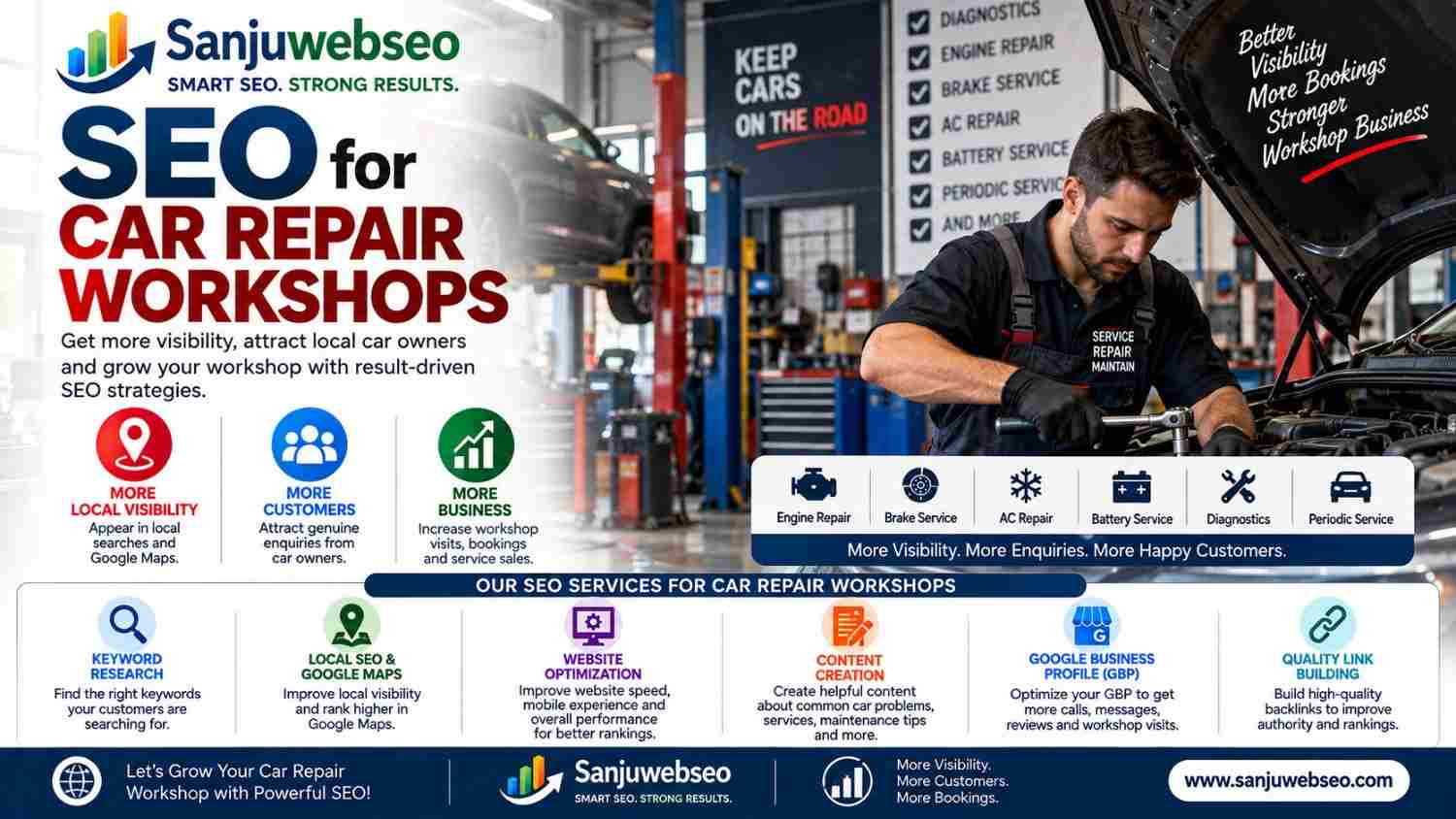
When a Car Problem Becomes a Google Search
SEO for Car Repair Workshops helps repair businesses become visible when vehicle owners suddenly need professional assistance. A driver may search for a car repair workshop near me after hearing an unusual engine sound, noticing a warning light, facing a battery problem, or needing urgent brake repairs. Unlike many industries, automotive repair searches can happen when the customer already has a specific problem and wants a practical solution quickly.
This makes search visibility especially valuable for workshops. Customers want to know whether the workshop handles their problem, where it is located, whether it is open, what services it provides, and whether other vehicle owners trust it. Your website should answer these questions without making customers dig through unrelated information. A clear online presence can turn an urgent search into a phone call, direction request, or workshop visit.
Build Content Around Actual Vehicle Problems
Car owners do not always know the technical name of a mechanical issue. They may search for symptoms instead. Phrases such as “car making noise while braking,” “engine warning light repair,” “car not starting,” or “AC not cooling” can represent genuine service needs.
Your content should address these situations in simple language. Explain common symptoms, possible causes, when professional inspection becomes important, and what type of service your workshop provides. Avoid presenting a diagnosis based only on a search query. Instead, help the customer understand the issue and guide them toward professional inspection. This creates useful content while matching the way vehicle owners actually search.
Make Your Core Services Easy to Find
A workshop may offer engine repair, brake service, clutch work, suspension repair, battery replacement, wheel alignment, AC repair, diagnostics, periodic servicing, detailing, or other automotive services. Customers should not have to search through one generic services page to find what they need.
Create clear service sections for the major work your workshop genuinely provides. Each page can explain the problem the service addresses, common signs, the inspection process, and what customers should expect. Service-specific pages can then capture searches with stronger intent while helping visitors understand whether your workshop is suitable for their vehicle problem.
Local Search Matters When the Car Cannot Go Far
A customer dealing with a breakdown or urgent repair usually does not want to travel across the city unnecessarily. Distance, accessibility, opening hours, and availability can become major factors in choosing a workshop. That makes local search particularly important for automotive repair businesses.
Your location should be clear across the website and Google Business Profile. Include accurate address details, service areas, opening hours, directions, and relevant photographs. Local SEO can help your workshop appear when nearby vehicle owners search for repair services, mechanics, diagnostic centres, tyre-related services, or specific automotive repairs.
Emergency Searches Need Fast Answers
Some repair searches happen under pressure. A vehicle may stop starting before work, overheat during a journey, develop a braking issue, or experience a battery failure. During these situations, customers are unlikely to read a long company introduction before deciding what to do.
Create a clear path for urgent enquiries. Your website should make important contact information easy to find, particularly on mobile. If your workshop offers roadside assistance, towing coordination, emergency repairs, or extended operating hours, communicate those services accurately. Never promise emergency support if the business does not actually provide it. Clear information is more valuable than exaggerated claims.
Show Your Workshop Expertise Through Service Details
Vehicle owners want confidence before handing their car to a repair business. They may wonder whether the workshop understands their vehicle type, uses suitable diagnostic equipment, has trained technicians, or handles a particular repair regularly.
Your website can demonstrate expertise through useful service information and genuine workshop details. Explain the types of vehicles or systems you work on, diagnostic capabilities, repair processes, equipment, and relevant experience where appropriate. Photographs of the actual workshop can also provide valuable context. These details help potential customers understand what happens after they contact the business.
Reviews Can Reduce Repair Anxiety
Choosing a repair workshop involves trust. Customers are handing over a valuable vehicle and may not always understand the technical work being recommended. Genuine reviews can therefore influence the decision, especially when several workshops appear in the same local search.
Encourage customers to share honest experiences about service quality, communication, repair work, turnaround time, and overall experience. Respond professionally to feedback rather than using the same response for every customer. A strong reputation comes from reliable work and transparent communication. Reviews then become evidence that supports the customer’s decision instead of merely acting as a ranking tactic.
Explain Repairs Without Making Customers Feel Lost
Automotive terminology can quickly become confusing. Terms such as suspension components, diagnostic trouble codes, transmission issues, brake components, wheel alignment, and electrical faults may be familiar to technicians but not to ordinary vehicle owners.
Useful content should translate technical information into practical language. Explain what the customer may notice, why inspection matters, and what the repair generally involves. Do not encourage customers to perform complicated repairs themselves. The purpose of the content is to help them understand the situation and make an informed decision about professional service.
Vehicle-Specific Searches Can Create Better Opportunities
Different vehicles can generate different repair needs. Customers may search for a service combined with a vehicle make, model, engine type, or location. For example, a vehicle owner may look for AC repair for a particular model or a workshop experienced with a certain vehicle brand.
Where your workshop genuinely has relevant experience, vehicle-specific content can be useful. However, do not create hundreds of pages simply by replacing one car model with another. Each page should contain meaningful information about the service, vehicle requirements, common issues, or workshop expertise. Unique value should determine whether a page deserves to exist.
Make Booking a Repair Less Complicated
Once a customer decides that a workshop may be suitable, the next step should be straightforward. They may want to call, request an estimate, ask about availability, share a vehicle problem, or schedule a service appointment.
Keep enquiry forms simple and avoid asking for unnecessary information. Important details such as phone number, workshop location, opening hours, and service options should remain easy to access. On mobile devices, click-to-call functionality can be particularly useful for urgent repair searches. A smooth enquiry process can help convert search visibility into actual workshop business.
Technical SEO Supports a Better Repair Experience
Automotive service websites often contain service pages, vehicle information, images, FAQs, location details, blogs, and contact pages. If these pages load slowly or become difficult to navigate, potential customers may leave before finding the information they need.
Technical SEO Services can address issues involving mobile performance, page speed, indexing, crawlability, broken links, website architecture, and other technical factors. A well-organized website helps search engines discover important service pages while making it easier for customers to move from a problem-related search toward a repair enquiry.
Use Google Business Profile as a Local Service Hub
For many repair workshops, Google Business Profile can become one of the first places customers interact with the business. A vehicle owner may check the workshop’s location, opening hours, reviews, photographs, services, phone number, and directions before visiting.
Keep these details accurate and update them whenever business information changes. Genuine photographs can show the workshop environment, equipment, team, or completed work where appropriate. Customers should receive the same basic information across your website and local profile. A consistent presence makes the workshop easier to evaluate when someone needs automotive help nearby.
Build Content From Questions Your Mechanics Hear Every Day
The service desk is a valuable source of content ideas. Customers may repeatedly ask whether a warning light requires immediate attention, how often a vehicle needs servicing, why brakes make noise, why an AC stops cooling, or what signs indicate a battery problem.
These real questions can become useful guides, FAQs, and service resources. Because they come from actual customer conversations, they are more likely to address genuine information needs. Content should remain accurate and avoid pretending that an online article can replace a physical inspection. The best objective is to help customers recognize when professional assistance makes sense.
Capture Maintenance Searches Before the Repair Becomes Urgent
Not every workshop visit starts with a breakdown. Many vehicle owners search for periodic servicing, oil changes, brake inspections, wheel alignment, battery checks, AC servicing, or general maintenance before a serious problem develops. These searches can bring customers who are actively planning a workshop visit rather than reacting to an emergency.
Create useful service content around regular maintenance where your workshop genuinely provides it. Explain what the service involves, why customers may consider it, and which signs can indicate that an inspection is needed. Helpful maintenance content can build visibility while encouraging vehicle owners to take care of problems before they become more expensive or disruptive.
Give Customers Better Answers About Repair Costs
Repair cost is one of the first concerns for many vehicle owners. However, the final amount can depend on the vehicle, fault, parts required, labour, and the extent of the damage. Publishing unrealistic fixed prices can create confusion when the actual repair requires additional work.
Instead, explain the factors that influence repair costs. Where appropriate, provide starting prices or typical service ranges only when the information remains accurate and clearly qualified. A transparent approach helps customers understand why an inspection may be necessary before providing a final estimate. It can also reduce misunderstandings when they contact the workshop.
Explain Genuine Parts and Replacement Options
Parts can influence both repair quality and customer confidence. Vehicle owners may want to know whether a workshop uses genuine parts, manufacturer-approved components, aftermarket alternatives, or customer-supplied parts. The right information depends on what your business actually offers.
Create clear service information explaining the available options and any relevant considerations. Avoid making blanket claims about one type of part being suitable for every vehicle. Accurate explanations can help customers ask better questions and understand the repair recommendation. This type of transparency can become an important trust signal for a workshop competing with other local service providers.
Service Pages Can Target Different Repair Needs
A single page titled “car repair” cannot fully answer every customer’s question. Brake problems, engine diagnostics, AC issues, suspension faults, battery problems, and periodic servicing involve different symptoms and expectations. Separate service pages can therefore provide more useful information when the workshop genuinely handles those repairs.
Each page should practically explain the service. Mention common symptoms, what an inspection may involve, and how customers can contact the workshop. Avoid creating pages simply by changing one service name while keeping identical content. Every important service page should offer information that is genuinely relevant to that repair.
Local Competition Makes Trust Even More Important
A vehicle owner may find several workshops within a short distance. When prices appear similar, customers can compare reviews, photographs, services, workshop experience, opening hours, and communication before deciding where to go.
Your website should make these differences easy to understand. Genuine workshop photographs, technician expertise, equipment information, service details, customer experiences, and clear contact options can help establish credibility. Local SEO can then bring the right audience to these pages. The combination of visibility and trust is more useful than ranking alone.
Build Location Relevance Without Creating Doorway Pages
A workshop may serve customers from several nearby areas, but that does not mean every neighbourhood needs a separate page. Pages created only by changing the location name can become repetitive and provide little value.
If you create location-specific content, give it a genuine purpose. Explain the workshop’s actual service area, access routes, nearby landmarks where useful, pickup or roadside assistance availability if offered, and other information relevant to customers in that area. This creates a better local resource while avoiding pages designed solely to capture minor keyword variations.
Make Your Google Business Profile Work Harder
For repair businesses, the Google Business Profile can become a major discovery point. A customer may search for a mechanic nearby and immediately compare map listings, ratings, opening hours, photographs, services, and directions.
Keep the profile information accurate and aligned with your website. Add genuine workshop photographs and relevant updates where appropriate. Encourage real customers to leave honest feedback and respond professionally. Sanju Web SEO’s Google Business Profile expertise can help businesses strengthen this part of their local search presence.
Use Before-and-After Content Carefully
Repair work can provide strong visual proof when photographs genuinely show the work performed. Before-and-after examples can demonstrate cleaning, component replacement, restoration, detailing, or other services where visual comparison makes sense.
However, photographs should represent real workshop work. Explain what problem the vehicle had and what service was completed without revealing private customer information. Authentic project examples can demonstrate practical experience more effectively than generic stock images. They also give prospective customers a better understanding of the workshop’s capabilities.
Prepare Repair Content for Conversational Search
Vehicle owners increasingly ask complete questions when looking for information. They may ask why a car shakes while braking, what causes an engine warning light, when brake pads need inspection, or why an AC is blowing warm air.
Useful content should answer these questions clearly while avoiding remote diagnosis. Explain possible causes, warning signs, and when professional inspection becomes appropriate. A broader AI SEO strategy can help organize related topics around customer intent and context. The content still needs accurate automotive information and should never replace professional vehicle inspection.
Connect Repair Content With Related Automotive Searches
Internal linking can help customers move between related services naturally. A page about brake repair can connect to periodic servicing, while a battery article can lead to relevant electrical or diagnostic services. A general vehicle maintenance guide can introduce customers to specific repair pages when the connection is useful.
The previous SEO for Car Dealers article can also be linked where the discussion involves dealership servicing, new-car owners, or the difference between dealership and independent workshop searches. These links create a connected automotive content network without forcing unrelated pages into the article.
Turn Local Searches Into Workshop Enquiries
A customer who searches for a repair workshop often wants to take action quickly. The website should make calling, requesting an estimate, asking about availability, or getting directions straightforward.
Keep important contact information visible on mobile devices. Service pages should include relevant calls to action instead of sending every visitor back to a generic contact page. Track phone calls, enquiry forms, direction requests, and service bookings to understand which pages generate meaningful customer actions. This helps connect SEO performance with actual workshop opportunities.
Measure SEO for Car Repair Workshops Through Real Customer Actions
Ranking reports can show where a workshop appears in search results, but they do not explain the complete business impact. Monitor which services attract organic visits, which search queries generate clicks, and which pages lead to calls or enquiries.
For example, a brake-service page may attract fewer visitors than a broad car-repair page but generate more qualified enquiries. That information can influence future content and optimization decisions. Regular review of Search Console, analytics, local visibility, and conversion data can help the workshop focus its SEO efforts on the services that matter most.
Why Choose Sanju Web SEO for Car Repair Workshop SEO?
Car repair SEO requires a strategy built around real vehicle problems and customer urgency. A person searching for brake repair has a different need from someone looking for periodic servicing, AC repair, diagnostics, or a nearby mechanic. Service pages, local visibility, useful explanations, reviews, and simple enquiry paths should work together.
Sanju Web SEO can combine keyword research, Local SEO, technical optimization, content development, Google Business Profile optimization, internal linking, authority building, and modern search strategies for automotive repair businesses. For practical SEO, AI-search, and digital marketing insights, you can also follow Sanju Web SEO on LinkedIn. The focus remains on relevant vehicle owners, qualified enquiries, workshop visits, and sustainable organic growth.
FAQ’s:-
Q1. How can SEO for Car Repair Workshops attract more customers?
SEO for Car Repair Workshops can help vehicle owners discover a workshop when they search for mechanics, repair services, diagnostics, servicing, brake repairs, AC repairs, or specific vehicle problems nearby. Service pages, local optimization, Google Business Profile information, reviews, useful guides, and clear contact options can support different stages of the customer journey. The strategy should focus on genuine services and real customer needs. When someone needs professional assistance, relevant search visibility can make it easier to discover the workshop and contact it.
Q2. What keywords should SEO for Car Repair Workshops target?
SEO for Car Repair Workshops should target searches related to actual repair services, vehicle problems, maintenance needs, locations, and customer questions. Examples may include car repair workshop near me, car mechanic near me, brake repair, car AC repair, engine diagnostics, car servicing, battery replacement, or service-and-location combinations. Symptom-based searches can also be useful when handled carefully. Keyword research should reflect services the workshop genuinely provides. There is little value in attracting visitors searching for repairs that your workshop cannot perform.
Q3. Can SEO for Car Repair Workshops improve Google Maps visibility?
Yes. SEO for Car Repair Workshops can support local discovery by keeping business information accurate and relevant across the website and Google Business Profile. Customers often look for a workshop’s location, opening hours, phone number, reviews, photographs, services, and directions before deciding where to go. Local SEO can strengthen the connection between the workshop and nearby searches. However, no SEO strategy can guarantee a specific Google Maps position. The priority should remain accurate information, genuine customer experiences, and strong local relevance.
Q4. How important are service pages for SEO for Car Repair Workshops?
Service pages are important because customers often search for a specific repair rather than a general workshop. Someone may need brake repair, engine diagnostics, suspension work, AC servicing, battery replacement, or periodic maintenance. A dedicated page can explain the symptoms, service process, and relevant customer questions more clearly than one generic page. Each service page should contain genuinely useful information and accurately represent what the workshop provides. Creating many pages with almost identical content can make the website repetitive and provide little additional value.
Q5. Can SEO for Car Repair Workshops generate emergency repair enquiries?
SEO for Car Repair Workshops can help businesses become visible for urgent searches such as car not starting, battery problems, overheating, brake concerns, or nearby mechanics. However, the workshop should clearly state whether it actually provides emergency assistance, roadside support, towing coordination, or extended operating hours. Customers searching during stressful situations need fast and accurate information. A mobile-friendly website, visible phone number, location details, and clear service information can reduce friction and make it easier for vehicle owners to contact the right business.
Q6. How can SEO for Car Repair Workshops build customer trust?
SEO for Car Repair Workshops can support trust by making the workshop’s expertise, services, location, reviews, processes, and customer experience easier to understand. Genuine photographs, technician information, service explanations, project examples, and authentic reviews can provide useful evidence. Transparent communication about inspections, estimates, parts, and repair limitations can further improve confidence. The website should never make unsupported claims about expertise or guarantee outcomes that depend on the vehicle’s actual condition. Trust grows when online information matches the service customers receive.
Q7. Should car repair workshops create pages for every vehicle brand?
Not necessarily. SEO for Car Repair Workshops should create vehicle-specific pages when the workshop genuinely has relevant experience and enough useful information to justify them. A page can explain supported models, common service requirements, diagnostic capabilities, or other relevant expertise. Simply creating dozens of pages by replacing one vehicle brand with another can produce repetitive content. Each page should provide meaningful value to customers. The strategy should reflect the workshop’s actual capabilities rather than creating pages solely to target additional keywords.
Q8. Is Google Business Profile important for SEO for Car Repair Workshops?
Yes. Google Business Profile is highly relevant because many vehicle owners search for repair workshops while they are already looking for a nearby solution. Accurate location, opening hours, phone number, services, photographs, directions, and genuine reviews can help customers evaluate the business quickly. Regularly checking the profile can also prevent outdated information from confusing customers. Google Business Profile should work together with the website and wider Local SEO strategy rather than being treated as a standalone marketing activity.
Q9. How long does SEO for Car Repair Workshops take to show results?
The timeline for SEO for Car Repair Workshops depends on local competition, website quality, existing authority, technical health, service demand, content quality, and the workshop’s current online presence. A small local workshop may face different conditions from a large automotive service chain. SEO generally requires consistent improvement rather than a single optimization. Businesses should monitor rankings alongside organic traffic, calls, direction requests, service enquiries, and bookings. These measurements provide a clearer understanding of whether search visibility is generating useful opportunities for the workshop.
Q10. Why choose Sanju Web SEO for SEO for Car Repair Workshops?
Sanju Web SEO can create a repair-focused strategy around vehicle problems, maintenance searches, service categories, local competition, workshop expertise, and customer intent. The approach can include keyword research, Local SEO, technical SEO, content planning, Google Business Profile optimization, internal linking, authority building, and modern search optimization. Instead of producing repetitive pages for keyword variations, the focus can remain on useful service information and genuine customer needs. This helps repair workshops attract relevant vehicle owners, generate qualified enquiries, increase workshop visits, and build sustainable organic visibility.