
Car Buying Starts Long Before the Showroom Visit
SEO for Car Dealers helps dealerships become visible while potential buyers are still researching their next vehicle. A car purchase usually involves several stages. Customers may first compare brands, body styles, fuel types, features, safety ratings, prices, financing options, and ownership costs. Later, they may search for a specific model, dealership, test drive, exchange offer, or service facility. Your website needs to support these changing search needs instead of focusing only on a broad dealership keyword.
A dealership can use SEO to connect with buyers at different points in this journey. Model pages can answer product questions, comparison content can support research, and location pages can help customers discover nearby showrooms. Useful information about test drives, finance, exchange, delivery, and dealership facilities can then move visitors toward an enquiry. The strongest strategy reflects how people actually shop for vehicles.
Model Searches Can Reveal Strong Purchase Intent
Car buyers often move from general research to highly specific searches. Someone may begin by looking for the best SUV for a family and later search for a particular model, variant, engine, automatic transmission, colour, or price range. These searches provide valuable clues about what the customer expects to find.
Your website should create clear pages around the models and variants you genuinely sell. Include important specifications, available features, seating capacity, fuel options, dimensions, technology, safety information, and other verified details. Where appropriate, explain differences between variants in simple language. This gives customers useful information while creating stronger relevance for specific searches.
Build Pages That Answer the Questions Buyers Ask
A car buyer rarely wants only a list of specifications. They may want to know whether a vehicle suits city driving, whether it has enough space for a family, what features are included in a particular variant, or what they should check during a test drive.
Your sales team already hears these questions every day. Turn genuine customer questions into useful website content. Buying guides, model comparisons, ownership tips, feature explainers, and test-drive guides can support customers before they contact the dealership. This approach creates content around real buying decisions rather than publishing generic articles simply to increase website size.
Local Search Can Bring Buyers to Your Dealership
Car purchases often involve physical interaction. Customers may want to inspect a vehicle, compare variants, speak with a sales representative, take a test drive, or discuss finance and exchange options. Because of this, local search visibility can play a major role in dealership marketing.
Your dealership should have accurate business information across Google and relevant platforms. Location, opening hours, phone number, showroom photographs, dealership category, and customer reviews should remain consistent. A strong Local SEO strategy can help the dealership appear when buyers search for car dealers, showrooms, specific brands, test drives, or vehicle-related services nearby.
Make Test Drives Easy to Discover
A test drive can be one of the most important steps between research and purchase. Yet some dealership websites make customers search for the option instead of placing it where they naturally need it. If your dealership offers test drives, the website should explain how customers can request one and what information they need to provide.
Create model-specific test-drive opportunities where appropriate. Someone researching a particular car should not have to return to the homepage to find the booking option. Clear calls to action can reduce friction and help convert product research into genuine dealership enquiries.
Finance and Exchange Searches Need Clear Information
Vehicle buyers often consider financing, down payments, monthly instalments, exchange options, and ownership costs alongside the vehicle itself. These topics can influence whether a customer feels ready to contact a dealership.
If your dealership provides finance assistance or vehicle exchange services, explain them clearly without making unsupported financial claims. Customers should understand the basic process, required information, and next steps. Useful finance and exchange content can also capture search intent from buyers who are already moving closer to a purchase decision.
Your Dealership Reputation Can Influence the Final Choice
Two dealerships may offer similar vehicles, yet customers can choose one based on trust and experience. Reviews can reveal how previous customers felt about sales assistance, test drives, delivery, communication, documentation, and after-sales support.
Encourage genuine customers to share their experiences and respond professionally to feedback. Do not manufacture reviews or use repetitive responses that sound automated. A dealership’s reputation should reflect the experience customers receive. Positive feedback can then support the wider search journey when buyers compare local dealerships before making contact.
Make Every Vehicle Page Useful on Mobile
Car research frequently happens on smartphones. Customers may check a model while travelling, compare specifications during a conversation, or look for a nearby showroom after deciding which vehicle they want to see. A slow or confusing mobile website can therefore lose potential buyers at an important moment.
Vehicle pages should load efficiently and present important information without unnecessary scrolling. Pricing details, specifications, images, enquiry options, test-drive actions, dealership information, and contact details should remain easy to access. Technical improvements should support the buying journey rather than simply focus on technical scores.
Use Original Dealership Content to Stand Apart
Many dealerships publish similar manufacturer information. While official specifications remain useful, your website can become more valuable by adding dealership-specific information. Showroom photographs, genuine vehicle images, delivery experiences, local customer questions, test-drive guidance, and real team expertise can help differentiate your pages.
Original content also gives potential customers a reason to trust the dealership. A buyer can learn what the showroom experience is like, how the test-drive process works, what support is available, and what makes the dealership convenient. These details are difficult to communicate through generic manufacturer copy alone.
Connect Car Dealer Content With Strong SEO Foundations
A dealership website can contain model pages, variant pages, offers, locations, finance information, exchange pages, service content, blogs, and contact pages. Without a logical structure, important pages can become difficult to discover.
Keyword planning, technical optimization, internal linking, and content organization should work together. A relevant SEO Audit Services strategy can help identify structural or technical problems that affect important dealership pages. The goal is to create a website that both search engines and potential buyers can navigate easily.
Capture Buyers Who Already Know the Model They Want
Car buyers do not always search for a dealership first. Some already have a preferred model and begin looking for a nearby dealer where they can check availability, compare variants, arrange a test drive, or discuss the purchase. These searches can carry strong commercial intent because the customer has already completed much of the initial research.
Your website should make this stage easy. Model pages can connect to variant information, dealership details, test-drive options, finance assistance, and enquiry forms. If a buyer searches for a specific model in a particular city, the page should provide useful local information rather than simply repeating manufacturer specifications.
Make Offers Useful Without Turning Every Page Into an Advertisement
Offers can attract attention, but customers still need context before they respond. A discount or exchange promotion may change frequently, so outdated information can quickly damage trust. If your dealership publishes offers, keep dates, eligibility conditions, and other important details accurate.
Create dedicated offer content when there is a genuine reason to do so. Explain what the offer covers and how customers can learn more. Avoid exaggerated claims that make every promotion sound like a once-in-a-lifetime opportunity. Clear information can attract motivated buyers while maintaining a professional dealership experience.
Used Car and Exchange Searches Can Bring Ready Buyers
Customers looking for a new vehicle may also have an existing car they want to exchange. Others may search specifically for used vehicles before contacting a dealership. If your business handles pre-owned cars or exchange services, these searches deserve their own strategy rather than being hidden inside a general sales page.
Explain the exchange process, inspection steps, documentation requirements, and other relevant information accurately. For used vehicles, individual listings can include genuine photographs, model year, mileage, condition, key features, and other verified details. Clear information helps customers understand what they are considering before they enquire.
Give Buyers a Reason to Choose Your Dealership
A customer may find several dealers selling the same brand. The vehicle itself may be identical, so the dealership experience becomes an important differentiator. Buyers can care about knowledgeable staff, convenient location, transparent communication, test-drive availability, finance assistance, delivery experience, and after-sales support.
Your website should communicate these genuine advantages through specific evidence. Show your showroom, explain available services, feature real customer experiences, and answer common questions. Avoid making broad claims such as “best dealer” without supporting them. Trust grows when the website reflects what customers can actually expect.
Google Business Profile Can Influence the Showroom Decision
A potential buyer searching for a car dealer nearby may immediately check the map listing, reviews, photographs, opening hours, directions, and contact information. Your Google Business Profile therefore becomes part of the dealership’s buying journey.
Keep the profile accurate and updated as business details change. Use genuine photographs and encourage authentic customer feedback. Relevant services and business information should also remain consistent with the website. If your dealership needs professional help with local visibility, Google Business Profile expertise can support this part of the strategy.
Build Content Around Local Car-Buying Questions
Different cities can create different customer needs. Buyers may search for dealerships near a particular neighbourhood, test drives in their area, car finance assistance, exchange facilities, or specific vehicle models nearby. Local content can address these needs when the dealership genuinely serves those customers.
However, creating dozens of city or neighbourhood pages with the same text is not a useful strategy. Each local page should provide real value through relevant dealership information, service details, directions, availability information, or local customer considerations. Quality should always come before page quantity.
Use Video and Visual Content to Support Vehicle Research
Cars are highly visual products. Customers want to see exterior design, interiors, boot space, dashboard features, seating, technology, and other details before visiting a showroom. Useful photographs and videos can therefore support the research process.
Where possible, create original visual content rather than relying entirely on generic manufacturer assets. Walkaround videos, feature demonstrations, showroom photographs, and genuine delivery moments can add useful context. Keep media optimized so it does not slow the website. Visual content should answer buyer questions, not simply fill product pages with decoration.
Prepare Dealership Content for Conversational Search
Modern customers may ask complete questions instead of typing short keywords. They might ask which SUV is suitable for a large family, what to check during a test drive, whether a particular model is available nearby, or what factors affect the cost of owning a vehicle.
Your content should answer these questions directly and accurately. Use clear headings, concise explanations, factual information, and practical examples. A broader AI SEO approach can help organize content around intent and context. The priority should remain useful information that genuinely helps buyers make better decisions.
Earn Relevant Authority Instead of Chasing Random Links
Car dealerships can strengthen their online presence through relevant local and industry references. Automotive publications, local business resources, community websites, event partnerships, and legitimate industry mentions may create meaningful opportunities for visibility and authority.
A focused SEO link-building services strategy can help identify relevant opportunities instead of collecting unrelated backlinks. Quality matters because the purpose of authority building should be to strengthen credibility and relevance. Links should support the overall digital presence rather than become a separate activity disconnected from the dealership.
Make the Path From Search to Enquiry Simple
A potential buyer should not struggle to find the next step after landing on a vehicle page. If they want a test drive, quotation, exchange discussion, finance consultation, or showroom visit, that action should be easy to understand.
Keep enquiry forms short and mobile-friendly. Place relevant calls to action near useful information instead of forcing customers to scroll through long sales messages. Track which pages generate calls, form submissions, test-drive requests, and other meaningful actions. This helps the dealership understand which parts of its SEO strategy actually contribute to sales opportunities.
Connect Dealership Pages Into a Useful Journey
Internal linking can help visitors move naturally from research to action. A model page can connect to a variant comparison. A comparison article can lead to a test-drive page. A finance guide can connect to an enquiry page. Local showroom information can connect to directions and contact details.
Related SEO resources can also support the wider content network. For example, a dealership working on its website structure may benefit from SEO for E-commerce Businesses when online vehicle listings or digital purchasing features form part of its business model. Internal links should always provide a useful next step rather than interrupting the reader.
Measure Leads, Not Just Car-Related Rankings
Ranking for a vehicle-related keyword can look impressive, but the more important question is whether that visibility produces business opportunities. Track calls, test-drive requests, quotation enquiries, showroom directions, finance enquiries, exchange requests, and online interactions alongside organic traffic and rankings.
Search data can also reveal gaps. A model page receiving impressions but few clicks may need a stronger title and description. A page attracting visitors but generating no enquiries may need clearer information or a better call to action. Continuous measurement helps turn SEO into an ongoing business-growth process.
Why Choose Sanju Web SEO for Car Dealer SEO?
Car dealership SEO needs to reflect a complex buying journey. Customers research models, compare variants, check prices, read reviews, look for offers, find nearby showrooms, request test drives, discuss finance, and finally decide where to purchase. A strategy that focuses only on “car dealer near me” misses many of these opportunities.
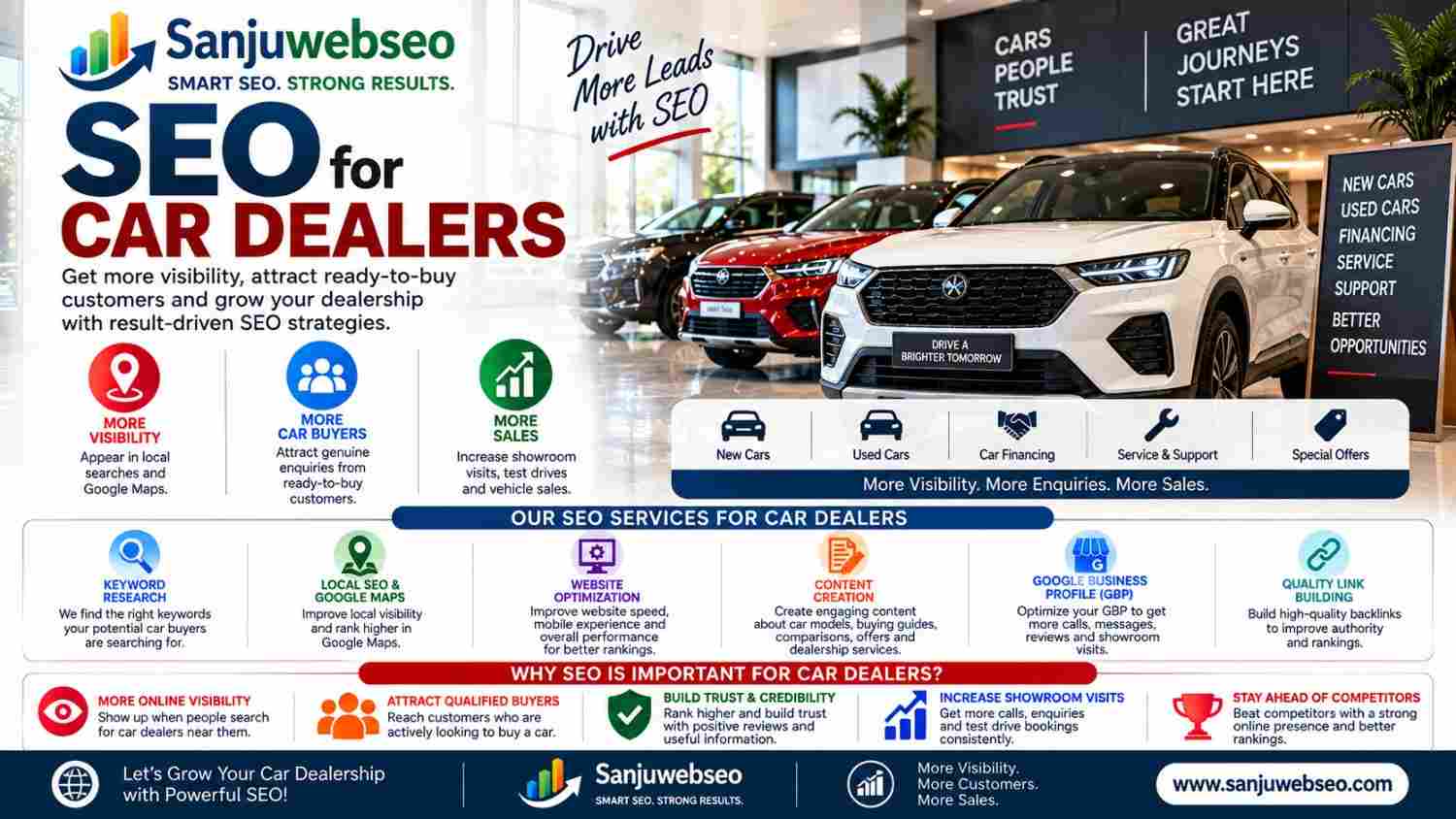
Sanju Web SEO can combine keyword research, technical SEO, Local SEO, content development, Google Business Profile optimization, internal linking, authority building, and modern search strategies around the dealership’s actual goals. For practical SEO and AI-search insights, you can also follow Sanju Web SEO on LinkedIn. The focus remains on qualified buyers, genuine enquiries, showroom visits, and measurable growth.
FAQ’s:-
Q1. How does SEO for Car Dealers help attract more buyers?
SEO for Car Dealers can help dealerships appear when customers research vehicle models, variants, prices, test drives, finance options, exchange services, and nearby showrooms. A strong strategy connects these different search stages with useful model pages, local information, buying guides, reviews, and clear enquiry options. The objective is not simply to generate website traffic. It is to attract people who have a genuine interest in purchasing a vehicle and make it easier for them to move from online research toward a dealership visit or enquiry.
Q2. What keywords should SEO for Car Dealers target?
SEO for Car Dealers should target searches connected to the vehicles, services, locations, and customer questions the dealership actually handles. These may include car dealer near me, car showroom, specific model searches, test drive queries, car exchange, used cars, or model-and-location combinations. Long-tail keywords can reveal strong purchase intent because customers often include their preferred model, variant, location, budget, or requirement. Keyword research should match real inventory and services rather than targeting popular vehicle terms that have no connection with the dealership.
Q3. Can SEO for Car Dealers improve Google Maps visibility?
Yes. SEO for Car Dealers can support local discovery by keeping dealership information accurate across Google Business Profile and relevant online platforms. Customers often check location, opening hours, phone numbers, photographs, reviews, and directions before visiting a showroom. Website content can provide additional context about models and dealership services. Local SEO does not guarantee a particular Maps position, but accurate information, genuine reviews, relevant content, and a trustworthy online presence can help customers discover and evaluate nearby dealerships.
Q4. How important are model pages for SEO for Car Dealers?
Model pages are important because many buyers search for a particular vehicle after completing their initial research. A useful model page should provide accurate specifications, features, variants, photographs, availability information where appropriate, and clear next steps such as requesting a test drive or enquiry. Additional content can explain important differences between variants and answer common buyer questions. Each page should contain genuinely useful information instead of simply reproducing generic manufacturer text. The objective is to support customers who are already considering a specific vehicle.
Q5. Can SEO for Car Dealers generate test-drive enquiries?
Yes. SEO for Car Dealers can attract visitors researching specific vehicles and guide them toward a test-drive request. Model pages, comparison content, local showroom information, and useful test-drive guidance can support this journey. The booking or enquiry process should remain simple, especially on mobile devices. Customers should understand what information they need to provide and what happens after submitting a request. Tracking test-drive enquiries separately can also help dealerships identify which models, pages, and search queries contribute to meaningful sales opportunities.
Q6. Is Local SEO important for SEO for Car Dealers?
Local SEO is highly relevant for SEO for Car Dealers because customers often want to visit a showroom, inspect a vehicle, take a test drive, or speak with sales staff. Location information, Google Business Profile optimization, reviews, directions, opening hours, and locally relevant website content can support these searches. Dealerships should focus on areas they genuinely serve. Creating multiple pages for locations without real business relevance can produce repetitive content and a poor customer experience rather than creating sustainable local visibility.
Q7. Can SEO for Car Dealers help promote used cars and exchange services?
Yes. SEO for Car Dealers can include used-car and vehicle-exchange searches when the dealership genuinely provides these services. Separate pages can explain available vehicles, exchange procedures, inspection processes, documentation, and other relevant details. Individual used-car listings should contain accurate information such as model year, mileage, condition, and genuine photographs. Exchange content should clearly explain the process without making unsupported valuation promises. These pages can attract customers who are considering a new purchase but need to understand what will happen with their existing vehicle.
Q8. How do reviews affect SEO for Car Dealers?
Reviews can influence customers when they compare dealerships selling similar vehicles. Buyers may look for feedback about sales representatives, test drives, communication, documentation, delivery, finance assistance, and after-sales support. Genuine reviews can provide reassurance and help customers understand the dealership experience. Businesses should encourage authentic feedback and respond professionally to concerns. Fake reviews, manipulated ratings, or repetitive responses can damage trust. Reputation should therefore grow from genuine customer service and accurate business information rather than artificial attempts to improve online ratings.
Q9. How long does SEO for Car Dealers take to show results?
The timeline for SEO for Car Dealers depends on competition, location, website authority, technical quality, content depth, model demand, and the dealership’s existing online presence. A dealership competing in a major city may face different challenges from one serving a smaller local market. SEO normally requires ongoing optimization rather than a single change. Businesses should monitor rankings together with organic traffic, calls, test-drive requests, quotation enquiries, direction requests, and showroom visits. These metrics provide a clearer view of whether SEO is contributing to actual dealership growth.
Q10. Why choose Sanju Web SEO for SEO for Car Dealers?
Sanju Web SEO can build a dealership-focused strategy around vehicle models, variants, local searches, test drives, finance, exchange services, customer questions, and competitive conditions. The approach can include keyword research, technical SEO, Local SEO, content creation, Google Business Profile optimization, internal linking, authority building, and modern search optimization. Rather than producing repetitive pages for minor keyword variations, the strategy can focus on useful information throughout the car-buying journey. This helps dealerships attract relevant buyers, generate enquiries, increase showroom visits, and build stronger organic visibility.


