SEO for NGOs Should Connect People With a Cause They Care About
SEO for NGOs should help the right people discover an organisation when they are searching for a cause, community programme, volunteering opportunity, donation option, or information about a social issue. Unlike a typical commercial website, an NGO website often serves several audiences at once. Donors want accountability, volunteers want meaningful opportunities, beneficiaries need accessible information, and journalists or partners may want evidence of the organisation’s work.
That makes SEO for NGOs less about pushing one service page toward the top of Google and more about building a trustworthy information system. The website should clearly explain what the organisation does, whom it serves, where it works, how programmes operate, and what measurable work has already been completed. Search visibility becomes much more valuable when it helps the right people understand the mission before they decide to participate.
Build Search Visibility Around the Issues Your NGO Actually Addresses
People do not always search for an NGO by its name. They may search for topics such as child education programmes, women empowerment initiatives, rural healthcare projects, environmental conservation activities, food distribution programmes, or community development organisations. These issue-based searches can introduce new audiences to an NGO.
Start by mapping the causes and programmes the organisation genuinely works on. Each major programme should have useful information about its purpose, target community, location, activities, progress, and outcomes. Avoid creating pages for social issues that the organisation does not actually address simply because those keywords have search volume. Relevance matters more than chasing unrelated traffic.
Create Dedicated Programme Pages With Real Information
An NGO’s programmes deserve more than a short paragraph on an “Our Work” page. If the organisation runs multiple initiatives, give each important programme a dedicated page. Explain the problem being addressed, the people or communities involved, the activities undertaken, and the current stage of the programme.
Where appropriate, include dates, locations, project partners, photographs, reports, measurable outputs, and updates. This gives visitors something concrete to evaluate. It also creates useful search content around specific initiatives. A programme page can become the central destination for people who discover the NGO through an issue-related search.
Let Impact Pages Show What Happened After the Funding or Effort
Impact is one of the most important areas for an NGO website because supporters want to understand what their contribution helped accomplish. Instead of publishing only broad statements, create impact stories with specific context.
For example, an education programme might explain the number of learners reached during a defined period, the type of learning support provided, the location involved, and what changed as a result. Where numbers are available, explain how they were measured. If a result is qualitative, provide the relevant story without presenting it as a statistically proven outcome. Accurate reporting strengthens the website far more than exaggerated claims.
Use SEO for NGOs to Build Stronger Donor Research Pages
Donors may research an organisation for several weeks before contributing. They can look for its mission, programmes, registration information, financial disclosures, previous work, leadership, annual reports, and donation process. These questions should not require visitors to search through unrelated pages.
Create a clear donor information area covering the questions the organisation can legitimately answer. Explain how donations are used, which programmes they support, and what reporting is available. If the NGO publishes annual reports or audited financial information, make those resources easy to find. A useful About Us page structure can also demonstrate why organisational transparency and clear information architecture matter when building trust online.
Make Donation Pages Clear Before Asking for Support
A donation page should not make visitors work to understand what they are supporting. Explain the purpose of the donation, available contribution options, the process, and any relevant information donors should know before completing the transaction.
If donations support a specific campaign, connect the payment process with that campaign’s explanation. If a general fund supports multiple programmes, explain that clearly. Avoid creating unnecessary friction through excessive fields or confusing navigation. The page should also work properly on mobile devices because many supporters may arrive through social media, messaging platforms, or search results on their phones.
Build Separate Content for Volunteers
Volunteers have different search intent from donors. Someone looking to volunteer may want to know the type of work involved, eligibility, location, time commitment, training, safety requirements, and whether opportunities are available remotely or in person.
Create a dedicated volunteer section that answers these questions. If the organisation runs different volunteer programmes, give meaningful opportunities their own pages where appropriate. A volunteer guide can also explain what happens after someone submits an application. This turns SEO traffic into a more informed pool of potential volunteers instead of simply increasing the number of website visitors.
Make Local NGO Search Intent Part of the Strategy
Many NGOs operate within specific cities, districts, states, or communities. A person may search for an NGO near them, a local volunteer opportunity, a community programme, or an organisation working on a particular issue in their area. Local SEO can help these searches lead to relevant information.
Create location pages only where the NGO genuinely has programmes, offices, or ongoing activity. Each page should contain unique information about the organisation’s work in that location. Do not create dozens of city pages containing the same paragraph with only the location name replaced. Local relevance comes from actual activities, community context, project information, and useful location-specific resources.
Connect SEO for NGOs With Google Business Profile
For NGOs with a genuine public-facing office or eligible local presence, Google Business Profile can support local discovery. Keep the organisation’s name, address, phone number, website, operating hours, category, photographs, and other profile information accurate and consistent.
Google Business Profile optimization can be part of a broader local search strategy where the NGO’s physical presence and audience make it relevant. The profile should complement the website rather than replace it. Programme details, impact information, donation resources, and volunteer instructions should remain available on the organisation’s own website.
Publish Reports That Search Engines and People Can Understand
Annual reports, programme reports, research documents, and impact assessments can become valuable SEO resources when they are properly organized. Do not upload a PDF and assume the information is automatically accessible to everyone. Create a summary page explaining what the report contains and link to the full document.
Use descriptive headings, dates, programme names, locations, and relevant terminology. Where possible, make important findings available as HTML text rather than placing every important detail inside an image or scanned PDF. This helps both users and search engines understand the organisation’s work.
Turn Field Knowledge Into Useful Educational Content
NGOs often have knowledge that is difficult to find elsewhere. Staff members may understand community challenges, programme implementation, awareness gaps, or practical solutions because they work directly in the field. That knowledge can become valuable educational content.
An NGO working in education could explain barriers affecting school participation. An environmental organisation could publish practical information about local conservation challenges. A healthcare-focused NGO could explain awareness topics using appropriately reviewed information. The content should distinguish organisational experience from broader research and should cite credible external sources when making factual claims that require evidence.
SEO for NGOs: Show the People and Partners Behind the Work
An organisation becomes easier to understand when visitors can see who is responsible for its programmes. Where appropriate, publish leadership profiles, team information, advisory roles, partner organisations, and programme responsibilities.
Keep these profiles factual. Explain relevant qualifications, roles, professional backgrounds, or responsibilities instead of relying on generic descriptions. Partnerships should also be represented accurately. If another organisation supports a project, explain the nature of that relationship rather than using a partner’s name simply to create an appearance of credibility.
For organisations developing a broader digital strategy, understanding digital marketing for organisations can also help connect search, content, social platforms, and conversion activities into one system.
SEO for NGOs: Use Testimonials and Stories Responsibly
Personal stories can communicate the human side of an NGO’s work, but they require care. Do not publish sensitive information, photographs, names, or personal details without appropriate permission. Children and vulnerable individuals require particular attention to privacy and safeguarding.
A strong story should provide context rather than turn someone’s hardship into promotional material. Explain the programme, the support provided, and the person’s experience only to the extent that it is ethical and permitted. Respectful storytelling can make impact understandable without compromising dignity.
Make NGO Content Accessible to Different Audiences
An NGO website may serve donors, volunteers, beneficiaries, journalists, researchers, partners, government bodies, and community members. These visitors may have very different levels of knowledge and different reasons for visiting.
Use clear navigation to separate major information paths. For example, “Our Programmes,” “Get Involved,” “Donate,” “Reports,” “Impact,” and “Contact” can help users reach the right information quickly. Important resources should not be hidden behind complicated menus. Accessibility also matters, so use readable text, meaningful headings, descriptive image alt text, captions where necessary, and mobile-friendly layouts.
Strengthen SEO for NGOs With Evidence-Based Content
Search visibility should not encourage an NGO to publish claims that cannot be supported. When discussing social problems, statistics, public health, environmental conditions, education outcomes, or economic issues, identify reliable sources and keep the information current.
An SEO audit can help identify technical and content issues that make important pages harder to discover or use. However, technical optimization should support the underlying information rather than distract from it. For NGOs, credibility comes from accurate documentation, transparent communication, and evidence-backed content.
Build Content Around Questions Supporters Actually Ask
Useful NGO content often starts with questions rather than keywords. Donors may ask how contributions are used. Volunteers may ask whether training is provided. Community members may want to know whether a programme is available in their area. Journalists may need organisational facts or programme documentation.
Create content that answers these questions directly. FAQ sections, programme guides, explainer articles, report summaries, and resource pages can all serve different search intents. Each piece should have a clear purpose and should lead visitors toward the next relevant resource instead of pushing every reader toward the same donation page.
Use AI Search Visibility Without Losing Organisational Accuracy
Search behaviour is increasingly conversational. People may ask an AI-powered search system which organisations work on a particular issue, which NGO operates in a certain region, or what a specific programme does. Clear, well-structured information gives these systems better material to interpret.
This does not mean writing content specifically for machines. Instead, explain programmes, locations, leadership, reports, outcomes, and organisational facts in a way that is easy for people to understand. Consistent terminology across important pages also reduces ambiguity. Resources explaining what AI SEO means can help organisations understand how structured, useful information can support newer search experiences.
Measure SEO for NGOs Beyond Website Traffic
Traffic alone does not show whether an NGO’s SEO strategy is working. Measure actions that matter to the organisation. These could include donation visits, completed donation actions, volunteer applications, programme enquiries, report downloads, newsletter subscriptions, partnership enquiries, or visits to important impact pages.
Compare performance by content type as well. A programme page may generate fewer visitors than an awareness article but produce more relevant enquiries. A report page may attract researchers or journalists who become valuable long-term contacts. Measurement should therefore reflect the NGO’s actual objectives rather than focusing only on rankings.
Keep Programme, Donation, and Impact Information Current
Outdated information can damage confidence quickly. A closed campaign that still appears as active, an old donation instruction, a former office address, or an outdated programme figure can create confusion.
Assign responsibility for reviewing important website sections. Programme pages, leadership information, contact details, donation instructions, reports, volunteer opportunities, and impact figures should have a clear update process. When a programme ends, explain its status rather than silently leaving old information active. Regular maintenance also gives search engines clearer signals about which information remains current.
Build a Long-Term SEO Resource Around the NGO’s Mission
SEO for NGOs becomes more sustainable when the website grows into a reliable knowledge resource rather than a collection of promotional pages. Programme information, research, reports, impact stories, volunteer resources, donor guidance, local initiatives, and educational content can work together to explain the organisation’s mission.
The strongest strategy is not necessarily the one that publishes the most pages. It is the one that documents the organisation’s real work clearly and makes that information easy to discover. When useful content, accurate evidence, technical accessibility, and genuine organisational activity support each other, search visibility can become a long-term channel for reaching people who are genuinely interested in the cause.
Build Professional Authority Around the Organisation’s Digital Work
An NGO’s digital presence can also benefit from consistent professional communication. Staff members, founders, programme leaders, and communication teams can share research findings, project updates, community insights, and educational resources through appropriate professional channels.
For organisations evaluating how an SEO partner approaches digital visibility, the professional profile of Sanju Web SEO on LinkedIn provides another point of reference. The same principle applies to NGO communication: professional visibility should reflect genuine work rather than simply repeating promotional claims.
FAQ’s:-
Q1. How can SEO for NGOs help an organisation reach more supporters?
SEO for NGOs can help an organisation appear when people search for causes, programmes, volunteering opportunities, donation information, or social issues related to its work. The strategy should connect those searches with useful pages that explain the organisation’s programmes, impact, locations, and ways to participate. The objective is not simply to increase website traffic. A successful approach should attract relevant visitors who may become donors, volunteers, partners, beneficiaries, researchers, or supporters.
Q2. What keywords should an NGO target?
An NGO should target keywords connected to its actual programmes, causes, locations, and audiences. These may include issue-based searches, programme-related terms, local searches, volunteer queries, donation-related searches, and educational questions. The exact keywords depend on the organisation’s work. An environmental NGO, for example, should not target education-related terms simply because they have higher search volume. Relevance and genuine organisational activity should determine the keyword strategy.
Q3. Does local SEO work for NGOs?
Local SEO can be useful for NGOs with a genuine local presence or programmes serving specific communities. People may search for organisations, volunteer opportunities, community programmes, or social initiatives in their city or region. Location pages should contain unique information about actual work conducted in that area. Google Business Profile can also support local discovery when the organisation has an eligible public-facing presence. The website should provide deeper programme and impact information than the business profile itself.
Q4. How can an NGO improve its donation page for SEO?
An NGO should clearly explain what donations support, how the contribution process works, and what information donors need before completing a donation. The page should be mobile-friendly, easy to navigate, and connected to relevant programme or impact information. If a campaign has a specific purpose, explain it clearly and keep its status current. Technical SEO also matters because slow or difficult-to-use donation pages can create unnecessary friction for people who are already willing to contribute.
Q5. Should NGOs create separate pages for every programme?
Separate programme pages are useful when initiatives have different goals, communities, locations, activities, or outcomes. A dedicated page gives the organisation enough space to explain what the programme does and provide evidence of its work. However, creating multiple pages with nearly identical content is not helpful. The structure should reflect meaningful differences between programmes. If two initiatives are substantially connected, they may be better presented through one comprehensive page with clearly separated sections.
Q6. Can NGO impact stories improve search visibility?
Well-developed impact stories can attract relevant searches and provide useful evidence about an organisation’s work. They are particularly valuable when they include genuine context such as the programme involved, location, timeframe, activities, and documented outcomes. However, stories should be published ethically and with appropriate consent. Personal information about beneficiaries should not be disclosed simply for SEO purposes. Search visibility should be a result of useful documentation, not a reason to compromise privacy or dignity.
Q7. What information should an NGO publish about its leadership?
An NGO can publish factual information about its leadership team, founders, programme directors, advisors, or other responsible personnel where appropriate. Useful details may include professional background, relevant qualifications, organisational responsibilities, and areas of work. The information should be accurate and updated when roles change. Leadership information can help visitors understand who manages the organisation, but it should not be exaggerated. Clear role descriptions are generally more useful than broad promotional claims.
Q8. How often should an NGO update its website?
There is no universal publishing frequency that every NGO needs to follow. More important is keeping important information accurate. Programme status, donation instructions, contact details, leadership information, volunteer opportunities, reports, project figures, and campaign information should be reviewed regularly. New content can be published when the organisation has something genuinely useful to share. A smaller number of accurate, well-maintained resources is more valuable than publishing frequent articles that provide little new information.
Q9. Can SEO help an NGO attract volunteers?
Yes. Volunteer-related searches can bring people who are actively looking for ways to contribute. An NGO should create useful volunteer pages explaining available roles, eligibility, locations, time commitments, training, application steps, and expectations. Different volunteer opportunities can have separate pages when they genuinely differ. Supporting articles can also answer questions people have before applying. Clear information helps attract better-qualified volunteers because visitors understand the opportunity before submitting an application.
Q10. How can Sanju Web SEO help with SEO for NGOs?
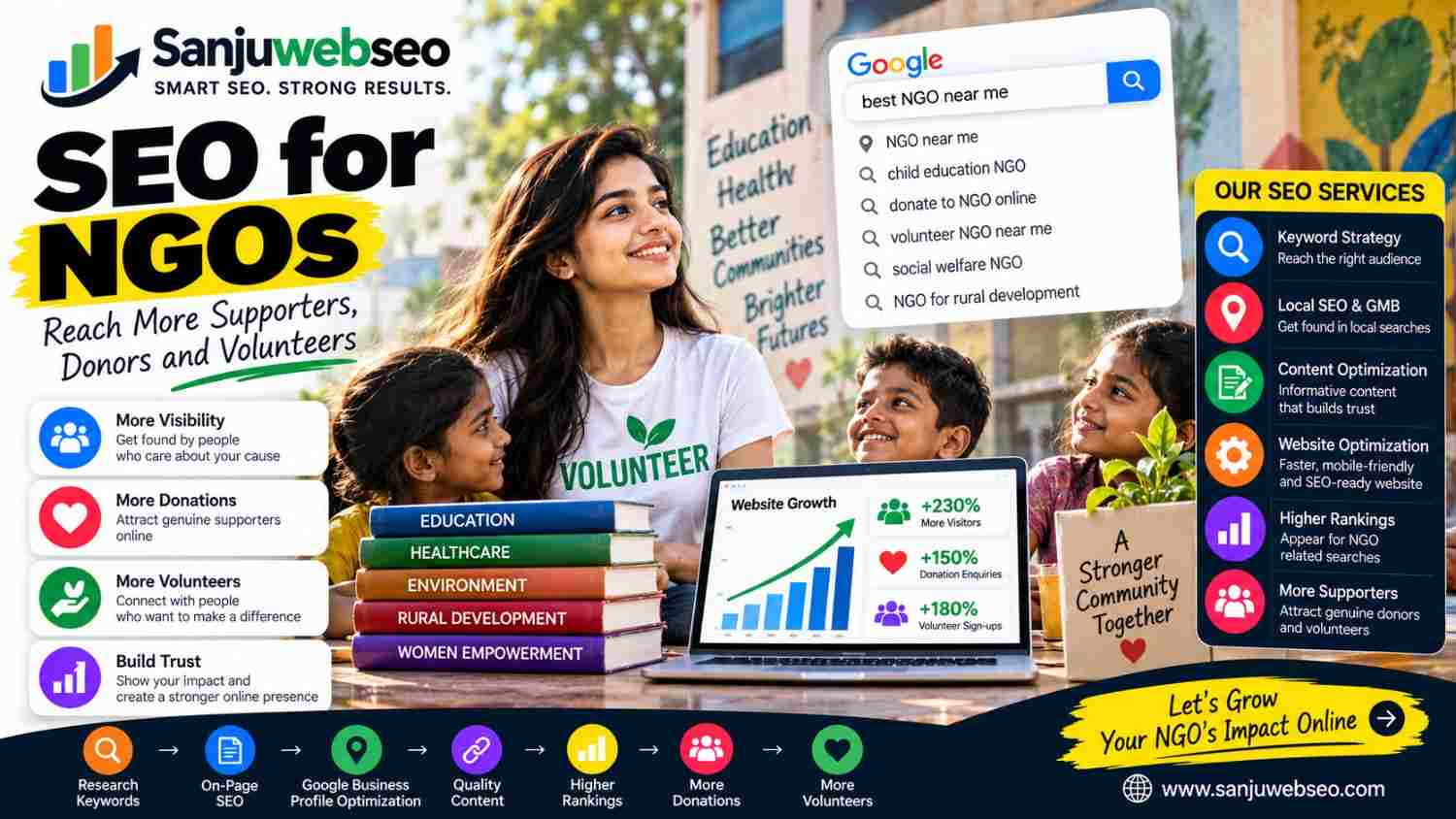
Sanju Web SEO can help NGOs build an SEO strategy around their causes, programmes, locations, content structure, local visibility, technical performance, and search intent. The process can include keyword research, on-page SEO, content planning, technical improvements, local SEO, Google Business Profile optimization, and performance analysis. The right approach depends on the NGO’s actual programmes, audiences, locations, website condition, and organisational goals. The objective should be to make useful information easier for relevant supporters and communities to discover.