
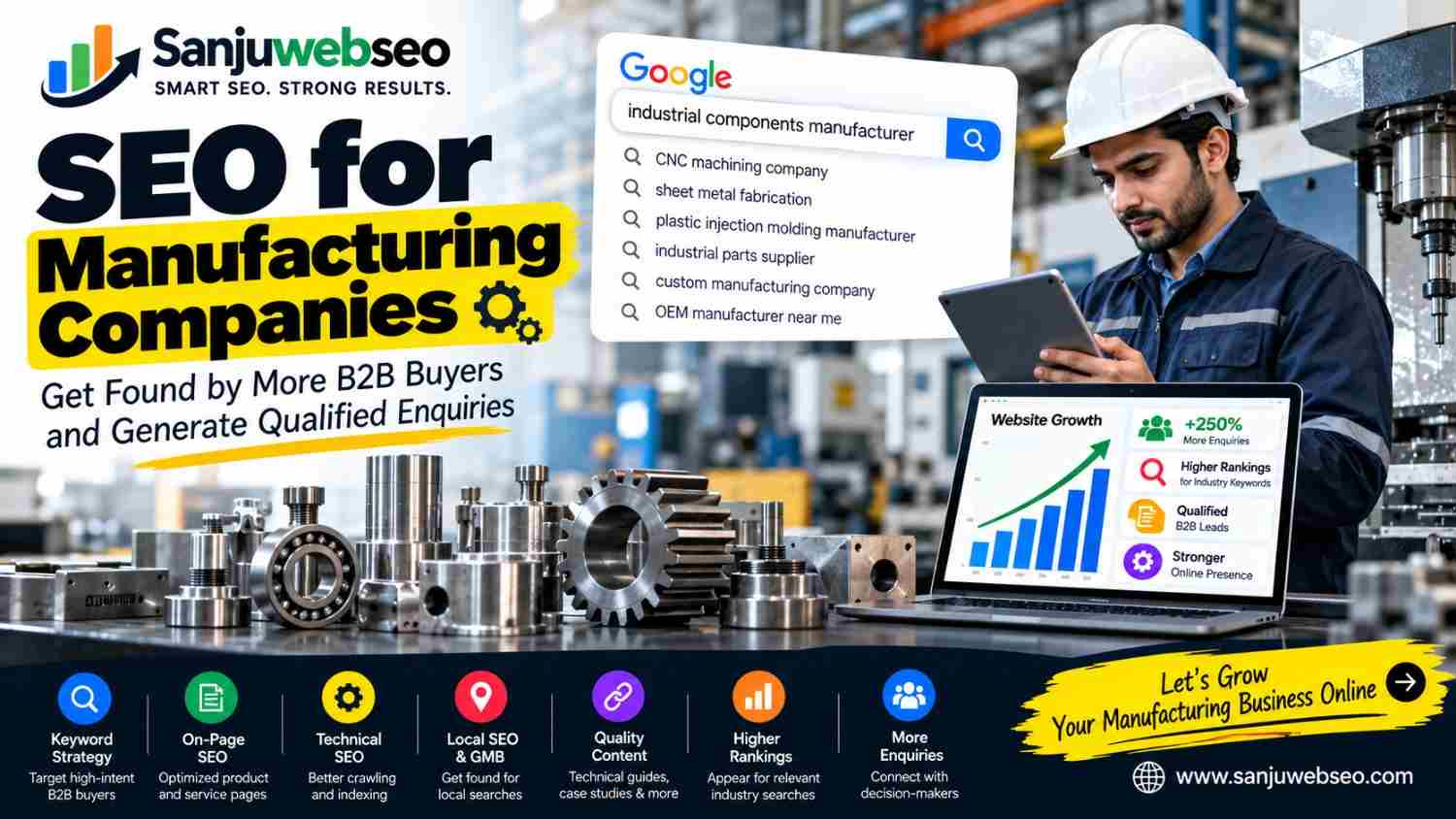
SEO for Manufacturing Companies Should Start With How Buyers Source Suppliers
SEO for Manufacturing Companies should help potential buyers discover the right manufacturer when they are researching products, components, materials, production capabilities, or suppliers. B2B buyers rarely make a manufacturing decision after reading one page. They may first search for a product, compare specifications, check production capabilities, review certifications, study industries served, and finally request a quotation. Your website should support this entire research process.
Manufacturing SEO therefore needs a different approach from ordinary local business marketing. A manufacturer may sell nationally or internationally, serve several industries, and work with technical specifications that consumers rarely understand. Useful SEO content should make those capabilities easier to discover while giving procurement teams enough information to decide whether the company deserves further consideration.
Create Product Pages Around What Buyers Actually Source
Manufacturers often list dozens of products under broad categories. That structure can make it difficult for search engines and buyers to understand exactly what the company produces. Instead, important product categories should have dedicated pages with meaningful information about applications, specifications, materials, sizes, production methods, and industries served.
For example, a manufacturer producing industrial fasteners could separate stainless steel fasteners, high-tensile fasteners, custom fasteners, and industry-specific components where those distinctions reflect genuine product differences. Each page should answer practical buyer questions rather than simply repeating the product name. This creates useful landing pages for both search engines and procurement professionals.
Use SEO for Manufacturing Companies to Explain Production Capabilities
A buyer may find a product page but still need to know whether the manufacturer can actually produce it at the required scale or specification. A dedicated capabilities section can explain machinery, manufacturing processes, production capacity, tolerances, materials, finishing options, inspection systems, and customization capabilities where applicable.
Avoid making unsupported claims such as “world-class manufacturing” or “best quality.” Specific information is more useful. If the company operates CNC machining, injection molding, sheet metal fabrication, forging, casting, extrusion, assembly, or another process, explain what the process is used for and what type of work the facility can handle.
Make Technical Specifications Easy to Find
Technical buyers should not have to contact the sales team for basic information that can reasonably be published online. Product dimensions, material grades, tolerances, load capacities, finishes, operating conditions, packaging information, or relevant standards can be valuable depending on the manufacturing category.
Use tables, downloadable datasheets, diagrams, and structured specifications when they genuinely improve understanding. Keep units consistent and explain technical terms when the audience may include both engineers and procurement professionals. Accurate technical content can attract highly specific searches and also shorten the early research stage for potential customers.
Give Each Industry Application Its Own Context
A manufacturer may supply the same type of component to multiple industries, but the application can differ considerably. An industrial component used in automotive manufacturing may have different requirements from one used in medical equipment or construction machinery.
Where there is genuine variation, create industry-specific application content. Explain the relevant use case, performance requirements, material considerations, compliance needs, and manufacturing considerations. This allows the website to target searches based on both product and industry rather than relying only on generic product keywords.
Show Certifications Without Turning Them Into Marketing Claims
Certifications can influence supplier evaluation, particularly in industries with strict quality, safety, or regulatory requirements. However, simply placing certification logos on a page provides limited information.
Explain which certification the company holds, what scope it covers, which facility or process it applies to, and whether it is currently valid. If a certification applies only to a particular manufacturing location or quality-management system, make that distinction clear. Supporting documents can be linked where appropriate. Accurate certification information is much more useful than a page filled with unexplained badges.
Build a Manufacturing Website Around Procurement Questions
Procurement teams often need answers that ordinary website visitors may never consider. They may want to know minimum order quantities, production lead times, packaging options, inspection procedures, customization capability, sample availability, delivery regions, or quotation requirements.
Create a dedicated procurement-oriented resource that answers these questions where the information can be shared publicly. This does not mean publishing commercially sensitive information. Instead, explain the general process so a prospective buyer knows what information to provide when requesting a quotation.
Make RFQ Pages Simple and Specific
A manufacturing enquiry should capture enough information for the sales team to understand the opportunity without making the form unnecessarily complicated. Depending on the product, useful fields may include product type, quantity, material, dimensions, drawing upload, application, delivery location, target timeline, and contact details.
The form should also explain what happens after submission. If technical drawings are required for a quotation, say so. If the sales team normally responds within a particular business timeframe, communicate that only when the company can consistently meet it. A clear RFQ process can turn high-intent organic traffic into genuine B2B opportunities.
SEO for Manufacturing Companies Should Support International Buyers
Many manufacturers serve customers outside their home city or country. In these cases, limiting the SEO strategy to local searches can unnecessarily restrict growth. Product, capability, application, and industry pages can target broader B2B searches when the company genuinely serves those markets.
International SEO also requires careful attention to terminology. Product names, technical terms, measurement systems, shipping information, certifications, and industry language may differ across markets. If the company has dedicated regional operations or genuinely different market information, location-specific pages can be useful. Avoid creating country pages with identical content and only changing the country name.
Use Case Studies to Demonstrate Manufacturing Experience
A manufacturing buyer may want evidence that a supplier has successfully handled a similar production challenge. Case studies can provide that evidence far better than generic statements about experience.
A strong case study can explain the customer’s requirement, manufacturing challenge, solution, production process, quality considerations, and final result. Confidential information should remain protected. When customer names cannot be disclosed, the case study can still describe the industry and application accurately if permission allows. Specific project context gives buyers a better understanding of what the manufacturer can actually handle.
Connect SEO for Manufacturing Companies With Quality Documentation
Quality documentation can become an important source of useful website content. Depending on the business, this may include inspection procedures, quality policies, testing capabilities, material certificates, process documentation, or relevant standards.
The purpose is not to upload every internal document. Instead, identify information that helps a prospective buyer understand how quality is controlled. For example, a manufacturer can explain incoming material inspection, in-process checks, final inspection, testing equipment, or traceability practices where these genuinely exist.
A properly structured SEO audit can also identify whether important product, technical, and documentation pages are difficult for search engines or users to discover.
Use Google Business Profile for Manufacturers With Local Facilities
Manufacturers often overlook local search because they focus on B2B or national keywords. However, buyers, suppliers, logistics partners, job candidates, and nearby businesses may still search for a manufacturer by location.
If the company has an eligible physical presence, keep its Google Business Profile information accurate. The profile should complement the main website by helping people confirm the facility’s identity and location.
Google Business Profile optimization can support this local discovery layer, particularly for manufacturers that receive local enquiries or operate identifiable facilities. Product and technical information should remain on the website rather than being forced into the business profile.
Publish Engineering and Manufacturing Knowledge
Manufacturers often have valuable technical knowledge that competitors may not explain clearly online. Engineers, production managers, and quality professionals can contribute educational content around materials, processes, tolerances, maintenance, component selection, common defects, or application considerations.
For example, a CNC machining company could explain the difference between machining processes and when each may be appropriate. A packaging manufacturer could explain material selection for different product categories. Such content can attract early-stage researchers and demonstrate practical knowledge without turning every article into a sales pitch.
Use Internal Links to Connect Products, Processes, and Applications
A manufacturing website can become difficult to navigate when product categories, technical resources, industries, and capabilities grow over time. Strategic internal linking can solve this problem.
A product page can link to its manufacturing process. A process page can link to relevant products. An industry application page can point to suitable components or case studies. A technical guide can introduce a relevant product category. This creates a connected information structure that helps both users and search engines understand relationships between pages.
For manufacturers planning broader digital growth, a strong digital marketing strategy can connect SEO with content, lead generation, paid campaigns, and other B2B acquisition channels.
Build Trust Through People, Facilities, and Real Evidence
Manufacturing websites often rely heavily on machinery photographs and product images. Those are useful, but buyers also want to understand the organisation behind the equipment.
Show relevant production areas, quality-control processes, engineering teams, testing facilities, warehouses, and other genuine aspects of the operation. Where appropriate, explain who manages technical, quality, or production functions. Real evidence is more persuasive than generic claims about professionalism.
The same principle applies to external professional visibility. Organisations evaluating the people behind an SEO service can also view Sanju Web SEO on LinkedIn for professional context.
Make Manufacturing SEO Useful for Distributors and Dealers
Not every visitor to a manufacturing website is the final buyer. Distributors, dealers, sourcing companies, contractors, and channel partners may also research manufacturers before starting a relationship.
Create suitable information for these audiences where they represent a meaningful part of the business model. Explain distribution opportunities, product ranges, territories, technical support, documentation, packaging, or ordering processes where the company can publicly share them.
This prevents the website from becoming focused only on one type of buyer. It also creates additional search entry points for B2B audiences that may generate long-term commercial relationships.
Create a Content Strategy Based on the Manufacturing Sales Cycle
Manufacturing SEO works best when content matches the stages of a technical buying journey.
| Buyer Stage | What the Buyer Needs | Useful SEO Content |
|---|---|---|
| Initial research | Understand products or processes | Product guides and educational articles |
| Technical evaluation | Check specifications and capabilities | Product pages, datasheets, process pages |
| Supplier comparison | Assess manufacturing suitability | Certifications, case studies, facility information |
| RFQ preparation | Understand quotation requirements | RFQ guides and enquiry pages |
| Supplier selection | Reduce operational risk | Quality information, references, documentation |
| Long-term relationship | Access ongoing support | Technical resources, updates, service content |
This structure prevents the website from becoming a collection of disconnected blog posts. Every content type has a role in helping the buyer move toward a meaningful business conversation.
Keep Product and Manufacturing Information Current
Outdated information can create serious problems for a manufacturer. A product may have been discontinued, a material specification may have changed, a machine may no longer be available, or a certification may have expired.
Review high-value pages regularly. Check specifications, downloadable files, certifications, production capabilities, contact information, facility details, and enquiry processes. If a product is no longer available, provide a useful alternative or clearly explain its status rather than leaving an outdated page active without context.
Measure SEO for Manufacturing Companies Through Qualified Leads
Manufacturing SEO should not be judged by traffic alone. A thousand visitors looking for general information may be less valuable than a smaller number of procurement professionals searching for a specific component or manufacturing capability.
Track organic enquiries, RFQ submissions, drawing uploads, phone calls, product-page engagement, downloads, and important search queries. Where possible, connect enquiries with actual sales opportunities. This helps identify which products, industries, and content areas generate commercially meaningful traffic.
Use Search Data to Discover New Product Opportunities
Search data can provide useful signals beyond rankings. Repeated searches for a product variation, material, application, or technical problem may reveal a demand pattern worth investigating.
SEO should not decide product strategy by itself, but search behaviour can contribute to market research. Sales teams can compare these patterns with customer enquiries and industry feedback. When both sources point in the same direction, the company may discover opportunities for new landing pages, product categories, technical resources, or future offerings.
Build a Long-Term B2B Search Asset
SEO for Manufacturing Companies should ultimately turn the website into a reliable digital catalogue, technical resource, and supplier evaluation platform. Product pages bring buyers into the website. Technical content helps them understand their requirements. Capability pages answer supplier questions. Case studies demonstrate real applications. Quality information reduces uncertainty. RFQ pages create a path toward commercial conversations.
The strongest manufacturing websites do not simply claim that they can manufacture something. They provide enough useful evidence for a buyer to understand what the company makes, how it makes it, where it is used, what standards apply, and how to start a conversation. That is where SEO becomes a genuine B2B growth asset rather than just a ranking exercise.
FAQ’s:-
Q1. How does SEO for Manufacturing Companies help generate B2B leads?
SEO for Manufacturing Companies helps potential buyers discover products, capabilities, technical resources, and supplier information through relevant searches. A strong strategy targets different stages of the B2B buying process, from early product research to technical evaluation and quotation requests. Dedicated product pages, capability information, case studies, certification details, and RFQ pages can attract more qualified visitors. The goal is not simply higher traffic. It is to make the website useful enough that relevant procurement teams feel confident taking the next step.
Q2. What keywords should manufacturing companies target?
Manufacturers should target keywords related to their actual products, materials, processes, applications, industries, and service areas. For example, a manufacturer may target searches around a particular component, fabrication method, material grade, or industry application. Product names alone may not capture the entire buying journey. Technical questions and problem-based searches can also attract early-stage buyers. Keyword selection should therefore reflect real products and capabilities rather than targeting unrelated high-volume terms.
Q3. Should every manufactured product have its own SEO page?
Not necessarily. A separate page is useful when a product has meaningful differences in specifications, applications, materials, or buyer intent. Products that are simply minor variations may be better organized within a broader category page. The objective is to create useful pages that provide information buyers actually need. Creating dozens of nearly identical product pages with only small keyword changes can create a poor user experience and provide little additional value.
Q4. Can manufacturing companies use local SEO?
Yes. Local SEO can help manufacturers attract nearby buyers, suppliers, distributors, contractors, and other businesses. It can also help people confirm the location and identity of a manufacturing facility. However, manufacturers serving national or international markets should not rely only on local keywords. Their strategy should also include product, industry, application, and capability searches. Google Business Profile can support local visibility when the business has an eligible physical presence.
Q5. What information should a manufacturing website include for procurement teams?
Useful information can include product specifications, manufacturing capabilities, minimum order requirements where appropriate, customization options, quality processes, certifications, packaging information, lead-time guidance, delivery regions, and quotation requirements. Not every company should publish commercially sensitive details. However, explaining the general procurement process can make it easier for potential buyers to submit complete enquiries. This can also reduce unnecessary back-and-forth between procurement teams and sales representatives.
Q6. How important are certifications for manufacturing SEO?
Certifications can be important because they may influence supplier evaluation in regulated or quality-sensitive industries. From an SEO perspective, certification pages can also provide useful information for buyers searching for qualified suppliers. The website should explain what each certification covers, its scope, relevant facility or process, and current status where appropriate. Manufacturers should avoid displaying certification logos without context or making claims that go beyond what the certification actually demonstrates.
Q7. Should manufacturers publish case studies?
Yes, when they can do so accurately and without violating customer confidentiality. Case studies can explain the original requirement, technical challenge, manufacturing approach, quality considerations, and result. They give potential buyers evidence of how the manufacturer handles real projects. If a customer cannot be named, the company may still be able to describe the industry and application with appropriate permission. Specific project context generally provides more value than generic statements about experience.
Q8. How can manufacturing companies improve their RFQ pages?
An RFQ page should make it easy for a buyer to provide the information required for a meaningful quotation. Depending on the product, this may include quantity, material, dimensions, specifications, application, delivery location, required timeline, and technical drawings. The form should avoid unnecessary fields while collecting information that the sales or engineering team genuinely needs. Explaining what happens after submission can also reduce uncertainty and improve the quality of enquiries.
Q9. What type of content works best for manufacturing SEO?
Useful manufacturing content can include product guides, technical explanations, process pages, application guides, material comparisons, quality information, case studies, FAQs, and procurement resources. The best topics depend on what buyers actually research before selecting a supplier. Technical content should be accurate and understandable to the intended audience. Manufacturers can involve engineers, production teams, or quality professionals in content creation so that important information reflects genuine operational knowledge.
Q10. How can Sanju Web SEO help with SEO for Manufacturing Companies?
Sanju Web SEO can help manufacturing companies develop an SEO strategy around products, technical capabilities, applications, industries, locations, and B2B buyer intent. The work can include keyword research, on-page optimization, technical SEO, content planning, internal linking, local SEO, Google Business Profile optimization, and performance measurement. The strategy should be based on the manufacturer’s actual products, markets, competition, website structure, and sales process rather than applying a generic SEO template.