
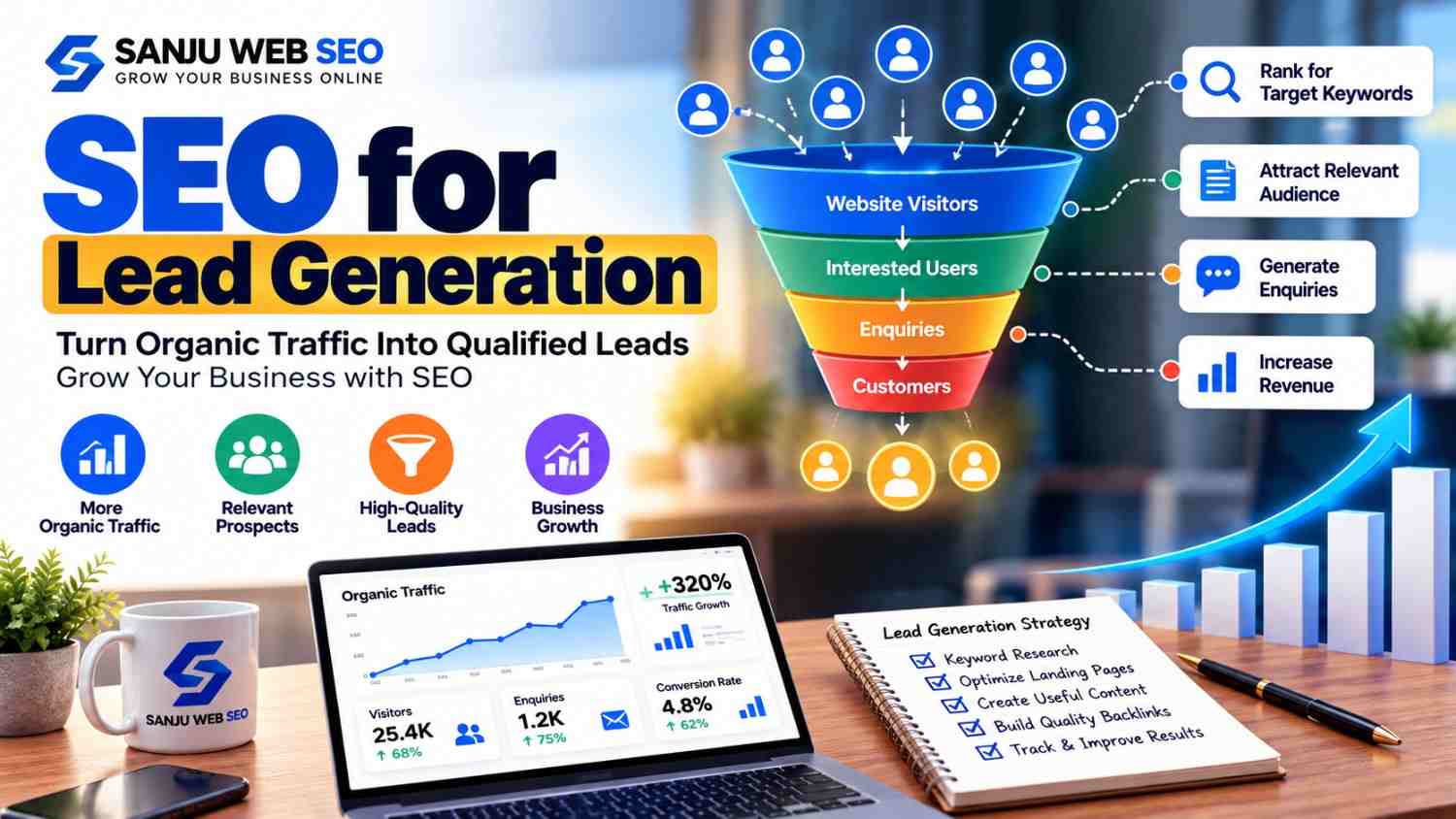
How Businesses Can Use Search Engine Optimization to Attract Better Prospects and Increase Enquiries
SEO for Lead Generation helps businesses attract people who are actively searching for relevant products, services, and solutions. Instead of focusing only on website traffic, this approach connects search visibility with meaningful actions such as enquiry submissions, consultation bookings, quote requests, and sales conversations.
However, attracting visitors is only the first step. A website may receive thousands of visits without generating enough qualified leads if its content targets the wrong audience or fails to explain the value of its services. Therefore, an effective SEO strategy must consider search intent, landing-page quality, trust, and conversion opportunities together.
For example, a B2B software company may attract potential buyers through comparison guides, while a professional service provider may generate enquiries through service pages that explain specific customer problems. Although their websites serve different purposes, both need to reach relevant users and make the next step clear.
This guide explains how businesses can improve organic lead generation through keyword research, helpful content, optimized landing pages, technical SEO, internal linking, and conversion tracking. It also covers common mistakes and a practical implementation plan.
1. Understand How SEO for Lead Generation Works
SEO for Lead Generation combines organic search optimization to attract and convert relevant prospects. Rather than treating rankings and traffic as the outcome, businesses evaluate whether their website reaches the right people and encourages useful enquiries.
The process generally involves four connected stages:
- Visibility: Your website appears for searches relevant to your services.
- Relevance: Your pages answer the questions and needs behind those searches.
- Trust: Visitors find convincing, accurate information about your business.
- Conversion: Interested visitors can take an appropriate next step.
Each stage supports the next. For instance, ranking for a keyword that attracts the wrong audience may increase traffic but produce few useful enquiries. Similarly, a relevant visitor may leave if the landing page does not explain the service or provide a clear contact option.
Consequently, the objective is not to maximize traffic at any cost. Instead, SEO for Lead Generation should help attract people whose needs match your business capabilities.
Distinguish Traffic From Qualified Leads
A website visitor is not automatically a potential customer. Someone reading a general educational article may simply want information, while another visitor comparing service providers may be closer to making a purchase.
Both audiences can be valuable. However, they need different content and calls to action.
For example, an introductory article might offer a related guide, whereas a service page could invite visitors to request a quotation. Matching the next step to the visitor’s intent makes the journey more useful and natural.
2. Find Keywords That Attract Potential Customers
Keyword research is a central part of SEO for Lead Generation because it helps businesses understand what their potential customers search for before contacting a provider.
However, choosing keywords solely because they have high search volumes can waste resources. A better approach considers relevance, search intent, competition, and the commercial value of the audience.
Start by listing your main services, customer problems, target industries, and frequently asked questions. Then, organize potential keywords according to the reasons people use them.
| Keyword type | Example search | Suitable content |
|---|---|---|
| Problem-based | How to reduce website maintenance costs | Educational article |
| Solution-based | Website maintenance services | Service landing page |
| Comparison-based | Website maintenance plans compared | Comparison guide |
| Commercial | Website maintenance pricing | Pricing or service page |
| Local | Website maintenance company in Indore | Relevant local service page |
| Decision-stage | Request website maintenance quote | Enquiry-focused landing page |
These are illustrative examples. Validate actual search demand and competition before prioritizing individual keywords.
Build Keyword Clusters Around Customer Intent
Group closely related searches that can be answered by one useful page. For example, several searches about website maintenance pricing may belong on a comprehensive pricing page rather than separate pages with almost identical content.
On the other hand, a distinct service that addresses a different customer need may deserve its own page.
This structure helps reduce unnecessary overlap between pages. Moreover, it allows you to plan a content journey from early research to service evaluation and enquiry.
For businesses reviewing their current website structure, an SEO audit can help identify missing pages, overlapping content, and optimization opportunities.
3. Create Landing Pages That Convert Relevant Visitors
A landing page should answer three essential questions: What do you offer? Who is it for? What should the visitor do next?
SEO for Lead Generation becomes more effective when the page matches the search query and provides enough information for a potential customer to evaluate the service.
For example, someone searching for business accounting services should find relevant information about the service, its scope, the types of businesses served, and how to request assistance. A generic homepage may not answer these questions as clearly.
Essential Elements of a Lead Generation Landing Page
A clear headline: Explain the service or solution immediately. Avoid vague statements that leave visitors guessing about what your business does.
Relevant benefits: Describe the problems you solve and the practical value customers may receive. Whenever possible, support claims with credible evidence.
Specific service details: Explain what is included, who the service suits, and any important limitations or requirements.
Trust-building information: Include genuine testimonials, case studies, credentials, business details, or examples of previous work where available.
A visible call to action: Give visitors a clear next step, such as requesting a quotation, booking a consultation, or contacting your team.
A practical enquiry form: Ask for the information necessary to respond effectively. Avoid requesting unnecessary details that make the form difficult to complete.
Match the Call to Action With Search Intent
Not every visitor is ready to purchase immediately. Therefore, the call to action should reflect the purpose of the page.
An educational article may encourage readers to explore a related service, while a commercial landing page can offer a consultation or quotation. Similarly, a comparison guide may help visitors understand the differences between available solutions before contacting a provider.
Avoid placing the same aggressive sales message on every page. Instead, make the next step relevant to the information the visitor has just received.
4. Publish Helpful Content That Supports Lead Generation
Content marketing helps businesses reach potential customers before they are ready to contact a service provider. It also gives them opportunities to demonstrate expertise and answer questions that might otherwise prevent an enquiry.
For this reason, SEO for Lead Generation should include more than service pages. A balanced content strategy can cover educational articles, practical tutorials, comparison guides, case studies, and frequently asked questions.
Choose Content Topics Based on Customer Problems
Start with the questions your sales team receives regularly. These questions often reveal concerns that customers want resolved before making a decision.
Useful content formats include:
- Educational guides: Explain a problem and the available ways to address it.
- How-to articles: Provide practical steps that readers can apply.
- Comparison pages: Explain meaningful differences between solutions.
- Case studies: Show genuine examples of work and measurable outcomes, with appropriate permission.
- Service explainers: Clarify what a service includes and who may benefit.
- Decision-making resources: Help readers evaluate requirements, pricing factors, and provider suitability.
For example, a web development company could publish a guide about choosing a website platform, a comparison of maintenance options, and a service page explaining its support plans. Each resource serves a different purpose while supporting the same business offering.
Make Content Original and Useful
Publishing many articles is not automatically better than publishing fewer, more useful resources. Instead, explain topics thoroughly, use relevant examples, and answer questions that competing pages may overlook.
Where appropriate, include original observations from your work, genuine customer experiences, or practical checklists. However, do not invent results, testimonials, credentials, or customer stories to make an article appear more authoritative.
You can also connect educational content with relevant service pages through descriptive internal links. For instance, readers learning about search optimization may benefit from exploring AI SEO services if that service genuinely matches their needs.
5. Strengthen Internal Linking Across the Customer Journey
Internal links connect related pages within your website. They help visitors discover useful information and give search engines additional context about the relationships between pages.
For SEO for Lead Generation, internal linking should help people move naturally from learning about a problem to evaluating a solution.
Consider a website with an educational article about improving online visibility. That article could link to a relevant service page, which could then guide interested visitors toward a consultation or enquiry form.
Build a Useful Internal Linking Structure
Follow these practices:
- Link from relevant articles to the service pages they genuinely support.
- Use descriptive anchor text that explains what the linked page offers.
- Connect related services where the relationship is useful to visitors.
- Include links to important pages in suitable navigation areas.
- Check for broken internal links and pages that receive no meaningful internal links.
- Avoid adding unrelated links simply to increase the number of links in an article.
Additionally, review whether your most important service pages are easy to reach. If visitors must navigate through several unrelated pages to find a contact option, the journey may become unnecessarily difficult.
A well-organized website supports both discovery and decision-making. Nevertheless, internal links should remain helpful rather than forcing every visitor through a predetermined path.
6. Improve Technical SEO to Remove Barriers
Technical SEO helps search engines access important pages and supports a reliable user experience. If a website has indexing problems, broken navigation, or poor mobile usability, potential leads may never reach the information they need.
SEO for Lead Generation therefore requires regular technical checks alongside content and keyword optimization.
| Technical area | What to review |
|---|---|
| Indexing | Confirm that important public service pages can be indexed. |
| XML sitemap | Include relevant canonical URLs that should be discovered. |
| Page titles | Give important pages unique, descriptive titles. |
| Meta descriptions | Summarize page content accurately and encourage relevant clicks. |
| Mobile usability | Ensure forms, navigation, and contact options work on smaller screens. |
| Page performance | Investigate slow loading and unexpected layout shifts. |
| HTTPS | Ensure pages use secure connections. |
| Redirects | Avoid broken destinations and unnecessary redirect chains. |
| Structured data | Use accurate schema markup that meets relevant guidelines. |
Make Forms and Contact Options Work Properly
Technical SEO is not limited to search engine crawling. The website must also function properly when a potential customer wants to get in touch.
Test your enquiry forms on desktop and mobile devices. Confirm that submissions reach the correct team, error messages are understandable, and visitors receive appropriate confirmation after submitting a request.
Furthermore, keep contact information accurate and ensure that important service pages do not contain broken buttons or outdated links.
These improvements do not guarantee more leads on their own. However, they help remove avoidable obstacles between a visitor’s interest and the next step.
7. Build Trust With Relevant Backlinks and Credible Information
Potential customers often compare several providers before choosing one. Therefore, your website needs to demonstrate credibility through accurate information, useful resources, and genuine evidence of your expertise.
Backlinks—links from other websites to yours—can help people discover your content and provide search engines with additional context. However, link quality and relevance matter more than collecting large numbers of links.
Practical Ways to Earn Relevant Backlinks
- Publish original research, useful reports, or industry-specific insights.
- Contribute expert explanations to relevant publications.
- Build genuine relationships with professional organizations and business partners.
- Create useful resources that other websites may want to reference.
- Maintain accurate profiles in legitimate, relevant business directories.
- Share original case studies when the information is authentic, and publication is authorized.
For example, a business that publishes a useful industry checklist may earn references from websites serving the same audience. Similarly, an expert contribution can introduce the company to relevant readers.
Avoid purchasing links intended to manipulate rankings or participating in schemes that generate artificial backlinks. Instead, focus on earning references through credible work and meaningful industry relationships.
Use Trust Signals Honestly
Trust also depends on what visitors see on your own website. Keep business details accurate, explain your services clearly, and use genuine customer feedback where permitted.
If you publish statistics or case studies, explain what the figures represent and avoid presenting exceptional outcomes as typical results without supporting evidence.
8. Measure Whether SEO Generates Qualified Leads
A successful campaign should measure business outcomes, not just rankings. SEO for Lead Generation needs reporting that connects organic search performance with enquiries and the quality of those enquiries.
Start by tracking the following metrics:
| Metric | Why it matters |
|---|---|
| Organic clicks | Shows how many visitors arrive through organic search. |
| Search impressions | Indicates how frequently pages appear in search results. |
| Relevant search queries | Helps assess whether the website attracts the intended audience. |
| Landing-page engagement | Shows how visitors interact with important pages. |
| Form submissions | Measures completed enquiry forms. |
| Qualified leads | Identifies enquiries that match your target customers. |
| Sales opportunities | Shows whether enquiries progress toward potential business. |
| Customer conversions | Helps connect marketing activity with actual business results. |
Use Google Search Console to review search queries, clicks, impressions, and page performance. In addition, use an appropriate analytics platform and CRM to understand what happens after visitors reach the website.
Track Lead Quality, Not Just Lead Quantity
A high number of enquiries may look encouraging, but some submissions may be irrelevant, incomplete, or outside your service capabilities.
Therefore, agree on a clear definition of a qualified lead with your sales team. For example, a qualified lead might meet your target industry, service requirements, location, or budget criteria.
Next, compare performance across landing pages and keyword groups. If a page attracts relevant visitors but few enquiries, review its content and call to action. Conversely, if a page generates qualified leads, identify what makes it effective and whether similar improvements could help other pages.
Remember that attribution can be complex. A customer may discover your website through organic search and return later through another channel. Use consistent tracking and interpret the results carefully instead of assuming every conversion has a single cause.
9. Follow a Practical 90-Day SEO Plan
A structured plan helps businesses prioritize work and measure progress. Although timelines vary, the following roadmap offers a practical starting point.
Days 1–30
Audit and research
Review technical SEO, existing service pages, keyword opportunities, internal links, analytics, and current enquiry performance. Identify the most important pages and establish a baseline.
Days 31–60
Optimize priority pages
Improve landing-page content, title tags, meta descriptions, internal links, mobile usability, and enquiry forms. Publish useful supporting content where meaningful gaps exist.
Days 61–90
Measure and refine
Review search performance, lead quality, conversion tracking, and content engagement. Use the available evidence to prioritize the next round of improvements.
During implementation, prioritize issues according to their likely impact and the effort required to resolve them. For example, fixing an indexing issue on a critical service page may deserve attention before publishing another general article.
However, do not expect every keyword to reach its target position within 90 days. Competition, website history, demand, and implementation quality all influence results. The purpose of this plan is to create a disciplined process, not to promise a particular ranking.
Common SEO Mistakes That Can Reduce Lead Quality
Even a well-planned campaign can underperform when it focuses on superficial metrics rather than customer needs.
Targeting irrelevant keywords: High-volume searches can bring visitors who are unlikely to need your services. Instead, prioritize searches that match your actual audience and offerings.
Sending every visitor to the homepage: Different searches require different information. Use relevant landing pages to answer specific questions and provide appropriate next steps.
Publishing repetitive content: Several articles that answer the same question may add little value. Consolidate overlapping material when appropriate and prioritize useful, distinctive information.
Using vague calls to action: Visitors should understand what happens when they contact you, request a quote, or book a consultation. Explain the next step clearly.
Ignoring mobile users: Difficult forms, tiny text, and broken buttons can discourage potential leads. Test important pages on common mobile screen sizes.
Buying artificial backlinks: Manipulative link schemes can introduce SEO risk without providing meaningful business value. Focus on genuine relevance and credible resources.
Failing to track qualified leads: Raw traffic and submission counts do not reveal whether the right prospects are reaching your business. Connect website reporting with lead qualification where possible.
Expecting immediate results: Organic search is an ongoing process. Monitor trends over meaningful periods and adjust your strategy as evidence develops.
Conclusion: Make SEO a Consistent Source of Relevant Enquiries
SEO for Lead Generation works best when keyword research, useful content, optimized landing pages, technical performance, and conversion tracking support the same business goals.
Begin by understanding what your potential customers search for and which services you can genuinely provide. Then, create pages that answer their questions, demonstrate your capabilities, and make it easy to take the next step.
At the same time, measure more than rankings. Track relevant organic traffic, qualified enquiries, and sales opportunities to understand whether your website is contributing to business growth.
If you want to strengthen your website’s search visibility, explore Sanju Web SEO for SEO guidance and services. You can also review its digital marketing services in Indore to understand how search optimization can support a broader marketing strategy.
For enquiries, call +91 9302110432. You can also visit the Google Business Profile or connect with Sanju Web SEO on LinkedIn.
FAQ’s:-
Q1. What is SEO for Lead Generation?
SEO for Lead Generation is the process of improving a website’s organic search visibility to attract relevant prospects and encourage meaningful enquiries. It combines keyword research, useful content, optimized landing pages, technical improvements, and conversion tracking. As a result, businesses can focus on attracting visitors whose needs match their services.
Q2. Why is SEO for Lead Generation important for businesses?
SEO for Lead Generation helps businesses reach people who are actively searching for relevant solutions. Moreover, it can build awareness, answer customer questions, and direct potential buyers to suitable service pages. However, the results depend on audience relevance, competition, website quality, and the effectiveness of the enquiry process.
Q3. Which keywords work best for SEO for Lead Generation?
SEO for Lead Generation can use problem-based, service-based, commercial, comparison, and location-specific keywords. For example, service pricing and provider comparison searches may indicate that users are evaluating their options. Nevertheless, keyword selection should reflect the business’s capabilities and search intent rather than search volume alone.
Q4. How can SEO for Lead Generation improve website conversions?
SEO for Lead Generation can support conversions by matching landing pages to search intent, explaining services clearly, building trust, and offering relevant calls to action. Additionally, simple enquiry forms and accessible contact information can reduce friction. Still, conversion results depend on the audience, offer, and user experience.
Q5. Does SEO for Lead Generation require a separate landing page for every keyword?
No, SEO for Lead Generation does not require a separate page for every keyword. Instead, group related keywords according to search intent and create one useful page when the searches share the same purpose. However, distinct services or customer needs may justify separate landing pages.
Q6. How long does SEO for Lead Generation take to produce results?
SEO for Lead Generation has no guaranteed timeline. Some technical improvements may produce observable changes sooner, whereas competitive keywords and new content may require sustained work. Therefore, website history, competition, demand, and implementation quality all influence the outcome.
Q7. Can small businesses use SEO for Lead Generation effectively?
Yes, SEO for Lead Generation can help small businesses reach relevant audiences without relying exclusively on paid advertising. For example, they can focus on specific services, suitable local searches, and useful content that answers customer questions. However, success depends on realistic targeting and consistent implementation.
Q8. What content supports SEO for Lead Generation?
Useful content for SEO for Lead Generation includes educational guides, comparison pages, case studies, service explanations, tutorials, and answers to common customer questions. Furthermore, content should reflect genuine expertise and connect readers with relevant next steps when appropriate.
Q9. How can businesses measure SEO for Lead Generation success?
Businesses can measure SEO for Lead Generation through organic clicks, relevant landing-page visits, form submissions, qualified leads, and sales opportunities. In addition, combining Google Search Console data with analytics and CRM reporting can help connect search activity with business outcomes.
Q10. What mistakes should businesses avoid in SEO for Lead Generation?
Businesses should avoid irrelevant keywords, repetitive content, vague calls to action, poor mobile usability, and artificial backlink schemes. Moreover, they should not measure success through traffic alone. Tracking qualified enquiries and improving pages based on evidence provides a more useful view of performance.