
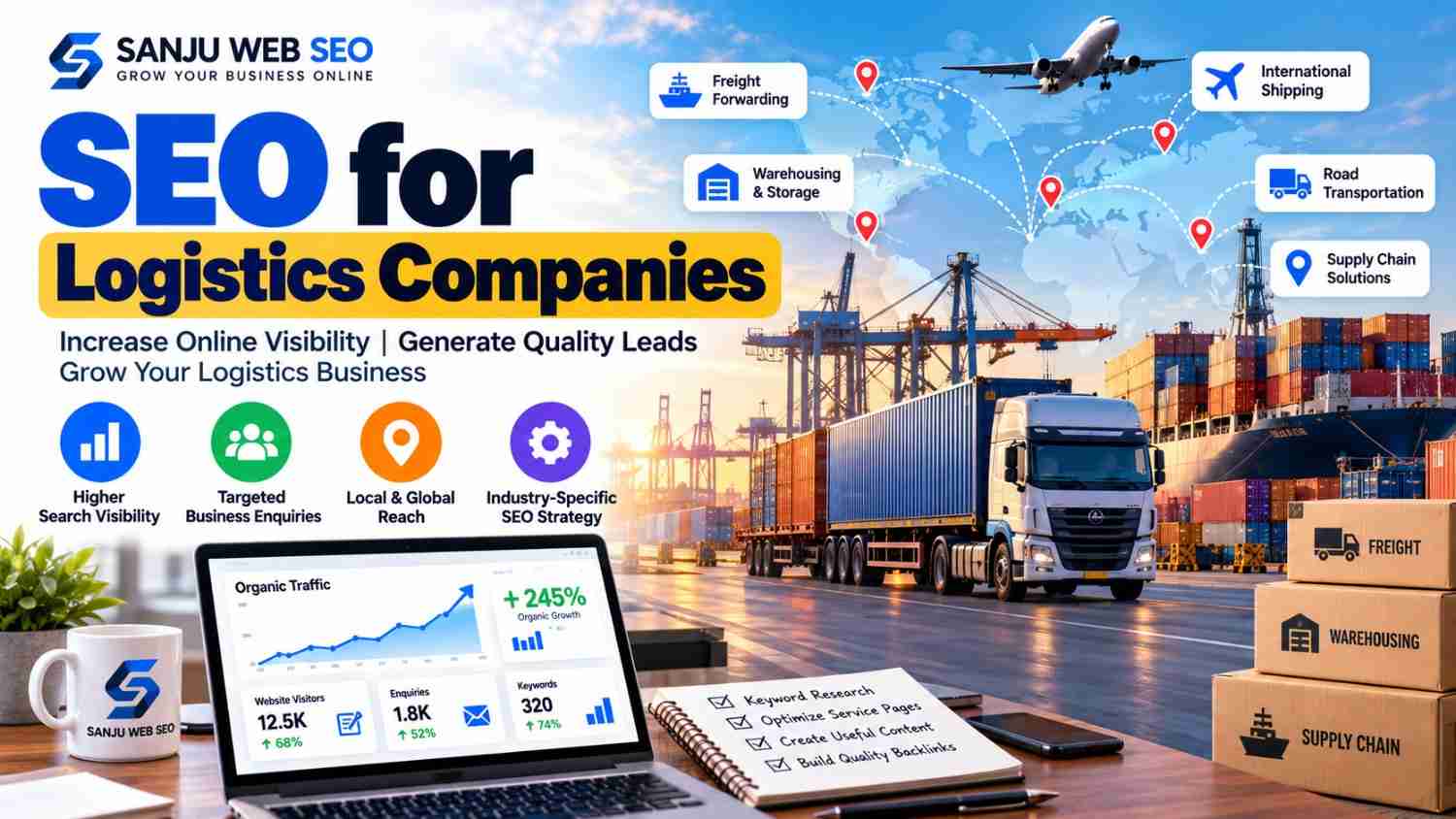
How Logistics Businesses Can Attract More Customers Through Search Engines
SEO for Logistics Companies helps logistics providers, freight forwarders, transport operators, warehousing businesses, and supply chain service providers reach potential customers through search engines. Instead of depending entirely on referrals and paid advertising, businesses can use search engine optimization to improve online visibility, explain their services, and attract relevant enquiries.
However, logistics SEO requires more than adding transport-related keywords to a website. Business customers often search for specific routes, freight solutions, storage facilities, shipment types, and industry requirements. Therefore, your website must clearly communicate what you offer, which locations you serve, and how customers can work with you.
For example, a company specializing in road freight between major Indian cities needs a different SEO strategy from a warehouse provider serving manufacturers and e-commerce businesses. Although both operate in logistics, their audiences, services, and search intentions differ.
This guide explains how to build a practical SEO strategy for logistics businesses, improve service pages, attract qualified enquiries, and measure meaningful results.
Why Logistics Companies Need a Strong SEO Strategy
Logistics businesses operate in a competitive market where customers compare service coverage, reliability, shipment handling, pricing, and delivery capabilities before selecting a provider. Consequently, your website should make it easy for potential customers to understand your strengths and evaluate your services.
SEO for Logistics Companies helps businesses become discoverable when prospects search for relevant transportation and supply chain solutions. Moreover, useful website content can answer questions that customers commonly ask before requesting a quotation.
Consider a manufacturer looking for a freight partner. The company may search for industrial goods transportation, full truckload services, warehouse facilities, or freight forwarding for international shipments. If your website explains these services clearly, it has a better opportunity to attract relevant visitors.
A strong SEO strategy can help your business:
- Improve visibility for relevant service-related searches.
- Reach potential customers in the locations you serve.
- Explain specialized transportation and warehousing services.
- Build trust through accurate business information and useful content.
- Generate enquiries from companies that need your services.
- Reduce exclusive dependence on paid advertising and personal referrals.
Nevertheless, SEO does not guarantee rankings or enquiries. Results depend on competition, website quality, service relevance, search demand, and consistent implementation.
1. Find the Right Keywords for Your Logistics Business
Keyword research should begin with your actual services and customers. Although broad terms such as “logistics company” may appear attractive, they do not always communicate what a searcher needs.
Instead, identify the services you provide, the industries you serve, the shipment types you handle, and the geographical areas you cover. Then, use these details to develop relevant keyword groups.
For example, a freight company may target different searches from a third-party logistics provider or a temperature-controlled warehouse operator.
Build Keyword Groups Around Services
Use these categories to organize your research:
| Keyword category | Example keywords |
|---|---|
| Core services | Logistics company, freight services, transportation services |
| Transportation type | Road freight services, full truckload transport, container transportation |
| Warehousing | Warehousing services, distribution warehouse, inventory storage |
| Specialized solutions | Cold chain logistics, project cargo transportation, hazardous goods logistics |
| Location-based searches | Logistics company in Indore, transport company in Mumbai |
| Commercial intent | Freight quotation, logistics service provider for businesses |
These are starting examples, not guaranteed high-volume keywords. Validate them using keyword research tools and actual customer language before assigning them to important pages.
Match Each Keyword to the Correct Page
Once you have grouped your keywords, map them to pages that genuinely satisfy the search intent.
For instance, your main logistics service page can explain your overall capabilities. Meanwhile, separate pages can cover warehousing, freight forwarding, road transportation, or cold chain services when these are distinct offerings.
This structure helps visitors find relevant information without forcing every keyword onto the homepage.
Additionally, review your competitors to identify useful topics they cover and questions their websites leave unanswered. Your objective should be to create more useful pages, not simply copy competitor headings.
2. Optimize Logistics Service Pages for Search and Enquiries
Your service pages are important because they explain what your company does and give potential customers a reason to contact you. However, a short paragraph containing transportation keywords may not provide enough information to support a business decision.
SEO for Logistics Companies should focus on pages that communicate real capabilities, service coverage, and customer benefits.
What Every Important Service Page Should Include
- A descriptive heading: Clearly identify the service, such as road freight transportation or warehouse management.
- Service details: Explain the shipment types, cargo requirements, handling procedures, or operational capabilities you genuinely support.
- Coverage information: Specify the cities, states, routes, ports, or countries you serve.
- Customer suitability: Explain which businesses or industries may benefit from the service.
- Trust signals: Include genuine certifications, relevant experience, documented processes, and customer testimonials when available.
- A clear call to action: Let visitors request a quotation, discuss shipment requirements, or contact your team.
For example, a page about warehousing should explain the type of storage available, inventory handling processes, access arrangements, and any specialized facilities. If you offer temperature-controlled storage, describe its actual capabilities rather than making unsupported claims.
Similarly, a freight forwarding page should clarify the services provided and the shipment requirements your company can handle.
The goal is to help visitors make informed decisions. As a result, a well-structured service page can support search visibility while also making the enquiry process easier.
3. Use Local SEO to Reach Customers in Your Service Areas
Many logistics businesses operate across specific cities, industrial areas, transport corridors, or regional markets. Therefore, local SEO can help them reach companies searching for nearby logistics providers or transportation services in a particular location.
However, local visibility should reflect your actual operations. A business should not create misleading location pages or claim to have offices in places where it has no legitimate presence.
Create Useful Location-Specific Pages
If your company genuinely serves multiple regions, consider creating pages that explain the services available in each area.
A useful location page might include:
- The transportation or logistics services available in that region.
- Major service areas or routes that your company actually covers.
- Relevant industrial sectors and customer requirements.
- Collection, delivery, or operational arrangements, where applicable.
- Accurate contact details and a clear enquiry option.
For example, a logistics provider serving manufacturing businesses around an industrial area could explain its freight services, coverage, and shipment handling process for that market.
Nevertheless, avoid publishing dozens of nearly identical pages that differ only by city name. Instead, include meaningful local information that helps customers understand your actual service capabilities.
Optimize Your Google Business Profile
If your business qualifies for a Google Business Profile, keep its information accurate and consistent with your real operations. Add the appropriate business category, contact details, operating hours, service information, and genuine photographs where relevant.
Also, request honest reviews from actual customers and respond professionally to feedback. However, do not offer incentives in exchange for positive reviews or create fake reviews.
You can review Sanju Web SEO’s Google Business Profile presence to see how a business profile can provide another way for potential customers to discover a company.
Remember that local SEO is only one part of the strategy. Businesses serving national or international markets also need strong service pages, useful content, and technically accessible websites.
4. Publish Content That Answers Logistics Customers’ Questions
A logistics website should do more than list its services. It should also answer practical questions that help potential customers understand transportation, warehousing, shipment planning, and supply chain management.
For this reason, content marketing can support SEO for Logistics Companies by attracting visitors who are researching logistics problems before choosing a service provider.
Content Topics Worth Exploring
Transportation and Freight Guides
Explain full truckload versus less-than-truckload shipping, freight documentation, shipment planning, and the factors that influence transportation costs.
Warehousing and Inventory Management
Cover stock handling, warehouse selection, inventory accuracy, distribution processes, and the role of storage in supply chain operations.
International Shipping and Freight Forwarding
Address shipment preparation, customs documentation, coordination between logistics partners, and common planning challenges.
These topics should reflect your actual expertise and services. For example, a road transport company does not need to publish detailed cold chain advice unless it has the knowledge and service relevance to support that topic.
Make Every Article Useful
Start each article with the customer’s question, then explain the answer clearly. Use realistic examples, practical checklists, and tables where they improve understanding.
Furthermore, link the article to a relevant service page so readers can explore the solution if they need professional assistance. Avoid inserting sales messages into every paragraph; useful information should remain the main purpose of the content.
You can also strengthen your broader digital strategy by reviewing digital marketing services in Indore and considering how content, organic search, and lead generation can work together.
5. Improve Technical SEO for Your Logistics Website
Technical SEO helps search engines discover, crawl, and understand your important website pages. It also supports a smoother experience for customers who may be accessing your website from mobile devices while arranging shipments or requesting quotations.
Even a well-written website can struggle if important pages are inaccessible, duplicate versions compete with each other, or navigation makes services difficult to find.
Use this checklist to identify common issues.
| Area | What to check |
|---|---|
| Indexing | Important public service pages should be eligible for indexing. |
| XML sitemap | Include relevant canonical URLs that you want search engines to discover. |
| Page titles | Write unique, descriptive titles for important pages. |
| Meta descriptions | Summarize each page accurately to encourage relevant clicks. |
| Mobile usability | Ensure navigation, forms, and contact details work on mobile devices. |
| Loading performance | Investigate slow pages, large images, and unnecessary scripts. |
| Internal links | Connect related service pages and helpful articles. |
| HTTPS | Ensure the website uses secure HTTPS connections. |
| Redirects | Update outdated URLs carefully and avoid unnecessary redirect chains. |
| Structured data | Use accurate, eligible schema markup that follows search engine guidelines. |
Make Important Information Easy to Access
Potential customers should not have to search through multiple menus to find your phone number, service coverage, or quotation form. Therefore, keep essential information accessible from relevant pages.
Also, ensure that important content is available to search engines rather than relying entirely on elements that may not render correctly. If your website uses JavaScript heavily, test whether search engines can access the essential page content and links.
For further improvement, review your site’s technical condition through an SEO audit. Prioritize problems that affect important pages instead of making technical changes without understanding their impact.
6. Build Trust Through Relevant Backlinks and Industry Relationships
Backlinks are links from other websites to your website. When relevant websites reference useful resources, these links can help people discover your business and provide search engines with additional context.
However, logistics companies should prioritize genuine industry relevance rather than simply increasing the number of backlinks.
Potential opportunities include:
- Industry publications discussing transportation or supply chain topics.
- Genuine business partners and logistics associations.
- Original research about freight operations or supply chain challenges.
- Useful guides that other industry websites may reference.
- Legitimate supplier, partner, or customer directories.
- Expert contributions that offer practical knowledge.
For example, a logistics company that publishes original findings about common warehouse inefficiencies may attract references from relevant industry websites if the research is credible and useful.
On the other hand, buying links purely to manipulate rankings, participating in excessive link exchanges, or creating large numbers of low-quality directory listings can introduce unnecessary risk.
Focus on relationships and resources that have genuine value for your industry. Although results may take time, this approach is more sustainable than relying on artificial link-building shortcuts.
7. Turn Website Visitors Into Qualified Logistics Leads
Getting visitors to your website is useful, but attracting the right businesses is even more important. A company looking for a one-time local delivery may have very different needs from a manufacturer seeking a long-term freight partner.
Therefore, your website should help potential customers identify the right service and submit an enquiry with minimal friction.
Improve the Enquiry Experience
Consider these improvements:
- Use specific calls to action: Offer options such as “Request a Freight Quote” or “Discuss Your Warehousing Needs.”
- Keep forms practical: Ask for essential details such as shipment origin, destination, cargo type, and contact information where appropriate.
- Explain your capabilities: Help visitors understand the routes, shipment categories, and services you actually support.
- Provide accessible contact options: Display accurate phone numbers, email addresses, and business contact information.
- Set clear expectations: Explain what information customers should provide to receive a useful quotation.
- Use genuine trust signals: Present verified testimonials, certifications, and documented experience where available.
For example, a freight quotation form that asks for the origin, destination, shipment type, and approximate cargo weight can help your team assess an enquiry more efficiently. However, collect only the information needed for the business process and handle customer data appropriately.
Connect SEO With Your Sales Process
SEO for Logistics Companies becomes more useful when the marketing team can understand which pages contribute to qualified enquiries.
Track whether leads originate from transportation pages, warehousing content, location pages, or educational articles. Then, where possible, connect that information with your customer relationship management system.
If a page attracts traffic but few relevant enquiries, examine whether it targets the wrong audience, provides insufficient information, or offers an unclear next step. Conversely, if a page generates qualified leads, consider improving its content and supporting it with relevant internal links.
The objective is not simply to increase form submissions. It is to attract businesses that match your services and have a genuine need for them.
8. Measure SEO Performance With Meaningful Metrics
A successful SEO strategy needs regular measurement. However, ranking reports alone cannot explain whether your logistics business is attracting useful customers.
Combine search performance data with website analytics and sales information to understand the full journey.
| Metric | What it tells you |
|---|---|
| Organic clicks | How many visitors arrive through organic search results. |
| Search impressions | How frequently your pages appear in search results. |
| Relevant search queries | Whether your pages appear for appropriate logistics services. |
| Landing-page engagement | Whether visitors interact with and explore your content. |
| Enquiry submissions | How many visitors submit a contact or quotation request. |
| Qualified leads | How many enquiries match your target services and customers. |
| Sales opportunities | Whether marketing enquiries progress into genuine business opportunities. |
Google Search Console can help you review search queries, impressions, clicks, and page performance. In addition, an analytics platform and CRM can help you understand what happens after a visitor reaches the website.
Review trends over meaningful periods rather than making decisions based on a few days of data. Search demand, competition, seasonality, and operational changes can all influence performance.
For example, if a service page receives impressions but few clicks, consider whether its title accurately communicates the offering. If it receives relevant traffic but few enquiries, review the content, contact process, and alignment between the page and the customer’s needs.
9. Follow a Practical 90-Day Logistics SEO Plan
A structured plan helps logistics businesses prioritize SEO activities instead of attempting everything simultaneously. The following roadmap is a starting point, not a promise of specific ranking results.
Days 1–30
Audit and research
Review your website’s technical condition, existing search performance, service pages, target customers, locations, and keyword opportunities. Establish a baseline for organic traffic and enquiries.
Days 31–60
Improve priority pages
Update the most important service pages, improve titles and descriptions, fix significant technical issues, strengthen internal links, and make enquiry forms easier to use.
Days 61–90
Publish and evaluate
Create useful supporting content, review local visibility where relevant, examine enquiry quality, and identify which pages need further improvements based on available evidence.
During this process, prioritize changes according to their likely business impact and implementation effort. For example, correcting an indexing problem affecting your main freight page may deserve attention before publishing another general blog article.
Additionally, review progress regularly and adjust the plan as new information becomes available. SEO is an ongoing process, and competitive searches may require sustained work beyond the first 90 days.
Common SEO Mistakes Logistics Companies Should Avoid
Even a well-planned campaign can lose effectiveness when it focuses on superficial metrics or repetitive content.
Targeting only broad keywords: General terms may attract visitors who do not need your particular services. Instead, include relevant service, location, and shipment-specific searches.
Creating duplicate location pages: Replacing one city name with another does not create meaningful local content. Each page should provide accurate and useful information about the service area.
Publishing thin service pages: A page with little information may fail to answer customer questions. Explain your capabilities, coverage, processes, and service limitations clearly.
Ignoring mobile users: Customers may visit your website from phones while coordinating transport or comparing providers. Consequently, contact details and quotation forms should work well on smaller screens.
Buying low-quality backlinks: Artificial link schemes may create risk without building meaningful authority. Prioritize relevant resources and legitimate industry relationships.
Making unsupported claims: Do not promise guaranteed delivery times, complete national coverage, specialized handling, or certifications unless your business can substantiate those claims.
Tracking traffic without lead quality: More visits do not automatically mean more business. Therefore, evaluate qualified enquiries and sales opportunities alongside search metrics.
Expecting immediate rankings: Search visibility depends on many factors, including competition, website quality, and implementation. Set realistic expectations and assess progress using evidence.
Conclusion: Build a Stronger Online Presence for Your Logistics Business
SEO for Logistics Companies is most effective when keyword research, useful service pages, technical improvements, local visibility, and lead tracking work together.
Start by identifying the services and markets that matter most to your business. Next, create clear pages that explain your capabilities, publish helpful content that answers genuine customer questions, and make it easy for interested companies to request information.
At the same time, measure more than rankings. Track relevant visitors, quotation requests, qualified leads, and sales opportunities so you can identify which activities support your business goals.
Consistent improvement is more valuable than publishing large volumes of repetitive content or chasing rankings without a clear purpose.
If you want to improve your website’s search visibility, explore Sanju Web SEO for SEO guidance and services. You can also connect with the business through its Google Business Profile or follow Sanju Web SEO on LinkedIn.
For enquiries, call +91 9302110432.
FAQ’s:-
FAQ’s:-
Q1. What is SEO for Logistics Companies?
SEO for Logistics Companies is the process of improving a logistics business’s visibility in organic search results. It includes keyword research, service-page optimization, technical improvements, relevant content, and link building. As a result, businesses can help potential customers discover their transportation, freight, warehousing, and supply chain services.
Q2. Why is SEO for Logistics Companies important for business growth?
SEO for Logistics Companies helps businesses reach companies searching for transportation and supply chain solutions. Moreover, it can improve service discovery, explain business capabilities, and support quotation requests. However, results depend on competition, website quality, customer demand, and how well the services match search intent.
Q3. Which keywords should businesses target with SEO for Logistics Companies?
Businesses should use SEO for Logistics Companies to target relevant service-based, location-based, shipment-specific, industry-specific, and commercial keywords. For example, these may include road freight services, warehouse management, or freight forwarding. Nevertheless, keyword selection should reflect actual business capabilities rather than search volume alone.
Q4. How can SEO for Logistics Companies improve local search visibility?
SEO for Logistics Companies can improve local visibility by helping businesses maintain accurate business information, create useful pages for genuine service areas, and collect honest customer reviews where appropriate. Additionally, companies should keep their contact details and service coverage consistent across their online presence.
Q5. Should SEO for Logistics Companies include separate pages for each service?
Yes, SEO for Logistics Companies can benefit from separate service pages when those services have distinct customer needs and enough useful information to justify individual pages. For instance, warehousing and international freight forwarding may require different explanations. However, similar services should not be split into repetitive pages merely to target minor keyword variations.
Q6. Can SEO for Logistics Companies generate freight and transportation enquiries?
Yes, SEO for Logistics Companies can attract potential customers who are actively searching for freight and transportation services. Furthermore, clear service pages, useful contact forms, and accurate coverage information can help visitors submit relevant enquiries. Still, the number and quality of leads depend on the business and its market.
Q7. How long does SEO for Logistics Companies take to show results?
SEO for Logistics Companies has no guaranteed timeline for results. Some technical improvements may produce observable changes sooner, whereas competitive keywords and new content may require sustained effort. Therefore, website history, competition, search demand, and implementation quality all influence the outcome.
Q8. What content should businesses publish for SEO for Logistics Companies?
Content for SEO for Logistics Companies can include practical guides about freight planning, warehouse management, shipping documentation, supply chain efficiency, and shipment preparation. In addition, businesses should answer questions their actual customers ask. This content should reflect genuine expertise and the services the company can support.
Q9. Are backlinks important for SEO for Logistics Companies?
Backlinks can support SEO for Logistics Companies when they come from relevant, trustworthy sources. For example, genuine industry partnerships, original research, and useful logistics resources may attract references. However, businesses should avoid manipulative link schemes and low-quality link acquisition.
Q10. How can businesses measure the success of SEO for Logistics Companies?
Businesses can measure SEO for Logistics Companies by monitoring organic clicks, search impressions, relevant landing-page visits, quotation requests, qualified leads, and sales opportunities. Furthermore, combining Google Search Console data with analytics and CRM reporting helps businesses understand whether organic search contributes to meaningful enquiries.