
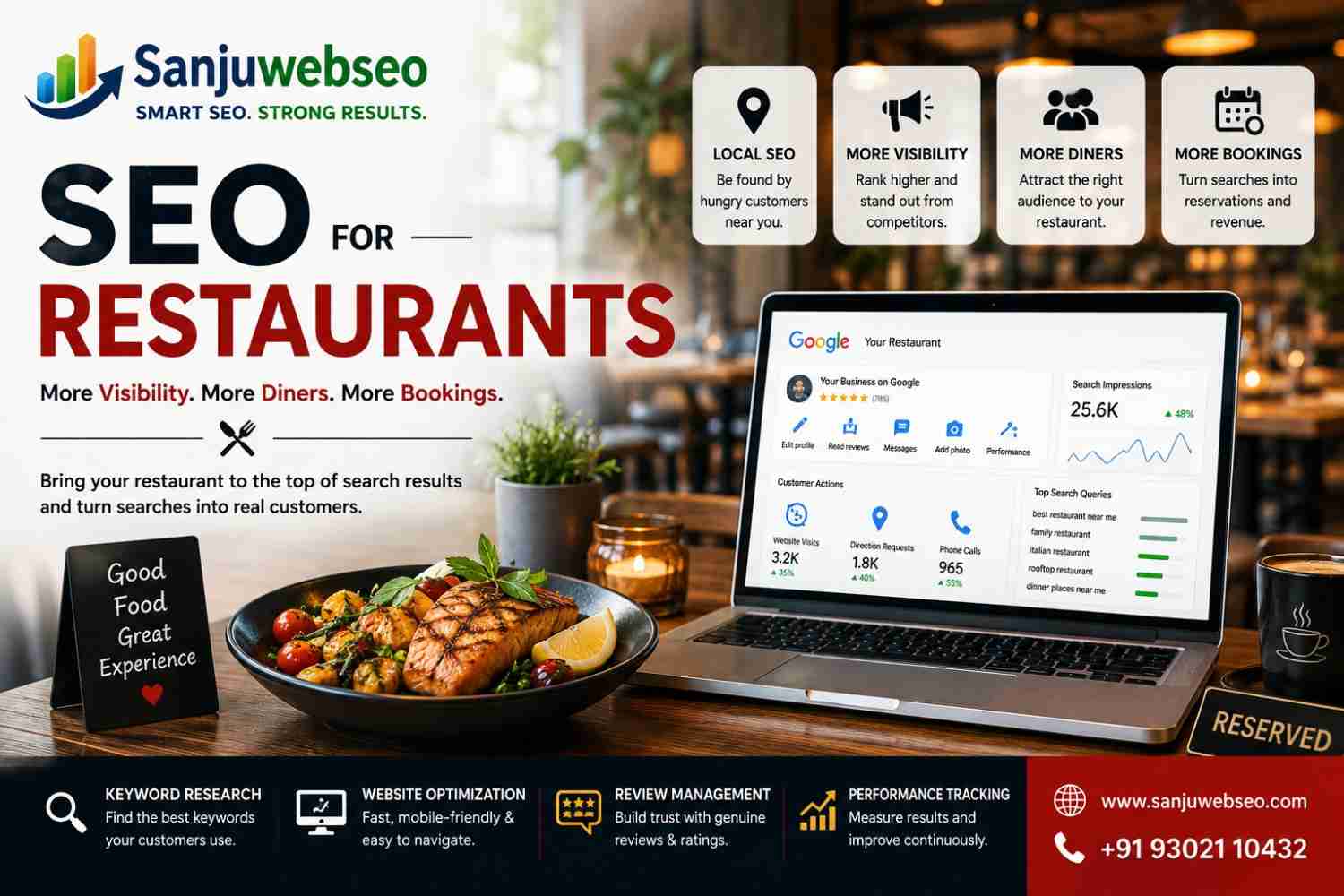
When Hunger Turns Into a Google Search
A hungry customer does not always search for a restaurant by name. They may search for a particular dish, cuisine, ambience, location, price range, or dining experience. Someone might look for a family restaurant nearby, while another person may search for the best biryani, rooftop dining, or a place for a weekend dinner. SEO for Restaurants helps your business become visible across these different moments of intent.
However, visibility alone does not guarantee a visit. Customers usually want to see the menu, food photographs, reviews, location, timings, and available dining options before making a decision. Your online presence should therefore answer those questions quickly. When search visibility and useful information work together, a Google visit has a much better chance of becoming a table booking, phone enquiry, walk-in, or food order.
Your Menu Is More Than a List of Dishes
Many restaurant websites treat the menu as a simple PDF or image. That can make it difficult for customers to explore individual dishes and understand what the restaurant actually offers. A stronger approach gives important categories and dishes useful descriptions. Customers can then discover the food they are interested in before deciding where to eat.
This also creates valuable search opportunities. Someone may already know the restaurant, but another person may be searching for a particular cuisine or dish without knowing your brand. Keyword Research Services can help identify these different search behaviours. The resulting strategy should focus on genuine menu items and customer intent rather than adding keywords that have no connection with the actual dining experience.
Build Pages Around the Reasons People Visit
A restaurant can attract very different types of customers. Families may look for comfortable dining. Couples may care about ambience. Office workers may search for lunch options. Tourists may want local cuisine. Someone planning an event may need a larger dining space. These needs should influence how the website presents the restaurant.
Instead of sending everyone to one generic homepage, useful pages can guide different audiences toward relevant information. A private dining page, event page, cuisine page, or special menu section can answer specific questions. Content Marketing Services can help develop these resources around real customer needs while keeping the website informative rather than repetitive.
Become Part of the Local Dining Decision
Restaurant searches are strongly connected with location. People often want to know what is available within a convenient distance before choosing where to eat. Your website should make the location obvious and provide practical information about parking, nearby landmarks, opening hours, and dining options when relevant. This helps customers evaluate convenience before they leave home.
Your Google Business Profile also deserves attention because customers can discover restaurants directly through Google Search and Maps. Google provides restaurant profiles with features for menus, photos, reviews, reservations, and ordering options, depending on eligibility and availability. Google Business Profile Optimization Services can help keep this local presence complete and aligned with the information on your website.
Make Food Photography Work Harder
A restaurant has one major advantage over many other local businesses: its products are highly visual. A strong food photograph can create immediate interest. However, random images are not enough. Customers want to see the actual dishes, dining environment, presentation, and overall atmosphere they can expect when they visit.
Use original photographs wherever possible. Organize them around dishes, dining areas, events, special menus, and genuine experiences. Your website can also provide useful context around popular dishes instead of displaying images without explanation. This combination gives visitors more information while making the restaurant feel real before they arrive.
Reviews Can Answer the Question: “Is It Worth Visiting?”
A customer who discovers an unfamiliar restaurant may immediately look at reviews. They want clues about food quality, service, ambience, portion sizes, cleanliness, waiting times, and overall experience. Reviews cannot replace your own information, but they can add an important layer of social proof. Genuine feedback can help a new customer feel more comfortable trying your restaurant.
Your reputation should also remain consistent across important platforms. Keep your restaurant name, address, phone number, opening hours, menu information, and dining options accurate. Respond to genuine reviews professionally and use customer feedback to understand recurring concerns. A strong reputation supports the wider customer journey because people can compare your restaurant with alternatives before making a decision.
Turn Restaurant Searches Into Actual Visits
Ranking on Google matters only when the visibility leads to action. A customer who discovers your restaurant should quickly find the information needed to make a decision: menu, location, timings, photos, reviews, reservation options, and ordering details. SEO for Restaurants should therefore connect search visibility with the next step in the customer journey instead of treating traffic as the final goal.
Your website should also make important actions obvious on mobile devices. Restaurant customers often search while travelling, commuting, or deciding where to eat at the last minute. Clear buttons for reservations, directions, calls, or online orders can reduce friction. A Conversion Rate Optimization approach can help identify pages where visitors leave without taking action and improve those experiences.
Local SEO for Restaurants Can Capture “Near Me” Intent
A customer searching for “restaurant near me” usually has stronger purchase intent than someone casually reading about food. Local SEO for Restaurants can help your business compete for these location-based searches by connecting your website, business information, reviews, and Google presence with the areas you genuinely serve.
Location relevance should remain natural. Instead of creating dozens of thin city pages, build useful location information around your actual restaurant, nearby neighbourhoods, landmarks, and customer needs. Local optimization can also support Google Maps visibility, where diners frequently compare restaurants before choosing one. Sanju Web SEO’s broader local SEO approach includes Google Business Profile optimization, Maps visibility, citations, reviews, and location-focused content.
Use Content to Answer Questions Before Customers Arrive
Restaurant customers often have questions that go beyond the menu. They may want to know whether you offer vegetarian dishes, family seating, private dining, parking, birthday arrangements, outdoor seating, delivery, or group bookings. Useful content can answer these questions before someone needs to call the restaurant.
This is where a restaurant content strategy becomes valuable. Instead of publishing generic food articles simply to target keywords, create resources based on real conversations with customers and staff. A page explaining your private dining options can support event enquiries, while a detailed guide to your signature dishes can help undecided diners understand what makes your menu different.
SEO for Restaurants Should Support Reputation and Discovery
Reviews can influence restaurant decisions because diners cannot fully evaluate food, service, or atmosphere before visiting. Your website should therefore complement genuine customer feedback rather than trying to replace it. Displaying authentic testimonials, press mentions, awards, or recognitions can add useful trust signals when those claims are accurate and verifiable.
Authority also grows when relevant websites, local publications, food communities, event platforms, and industry resources mention your restaurant naturally. Quality SEO Link Building Services can help identify legitimate opportunities without relying on irrelevant directories or manufactured backlinks. The objective should be to earn references that make sense for the restaurant and introduce it to people who may actually become customers.
Make AI Search Understand What Your Restaurant Offers
Customers increasingly use conversational search to ask complete questions instead of typing short keywords. They may ask where to find a specific cuisine, which restaurants suit families, or where they can celebrate a particular occasion. Your website should provide clear, structured answers that make the restaurant’s services and offerings easy to understand.
This does not mean creating a separate page for every possible search phrase. Instead, build genuinely useful content around your menu, location, dining experience, facilities, and customer needs. An AI SEO Expert in India can help businesses understand how search intent, entities, topical relevance, and modern search experiences fit together.
Why Sanju Web SEO for Restaurant Growth?
Restaurant SEO requires more than adding “restaurant” to website pages. The strategy should understand how people discover food, compare dining options, check reputation, explore menus, and finally decide whether to visit or order. Sanju Web SEO can build a restaurant-focused strategy around local search, content, technical performance, Google visibility, and conversion opportunities.
The process can begin with a detailed SEO Audit Services review to identify technical problems, weak pages, missing search opportunities, content gaps, and local visibility issues. From there, the strategy can prioritize changes that support real business goals such as reservations, calls, directions, walk-ins, event enquiries, or online orders. For a broader AI-driven search strategy, businesses can also explore AI SEO Services.
FAQ’s:-
Q1. How does SEO for Restaurants help attract more diners?
SEO for Restaurants helps your business appear when people search for nearby restaurants, specific cuisines, popular dishes, dining experiences, or places for special occasions. A well-optimized website can provide menus, photographs, reviews, location details, opening hours, and reservation information. This helps potential customers evaluate your restaurant before visiting. Local SEO can also improve your visibility in location-based searches and Google Maps. When customers find useful information quickly, they are more likely to call, request directions, reserve a table, visit your restaurant, or place an order.
Q2. What keywords should SEO for Restaurants target?
SEO for Restaurants should target keywords that match your actual menu, location, cuisine, services, and customer needs. These can include searches such as family restaurant near me, Italian restaurant in [city], best biryani restaurant, rooftop restaurant, vegetarian restaurant, or restaurant for birthday dinner. The right keywords depend on what your restaurant genuinely offers and what customers search for. Instead of targeting hundreds of unrelated phrases, create useful pages around important customer intents. This approach keeps your SEO strategy relevant while giving visitors information they can actually use.
Q3. Can Local SEO for Restaurants improve Google Maps visibility?
Yes, Local SEO for Restaurants can help strengthen your visibility in location-based Google searches and Maps. Start with accurate business information, including your restaurant name, address, phone number, opening hours, website, menu, and relevant categories. Genuine customer reviews and original photographs can also improve the quality of your online presence. Your website should support the same location information and clearly explain what you offer. Local optimization works best when your website and Google Business Profile provide consistent, useful information that helps nearby customers choose your restaurant.
Q4. How important are restaurant reviews for SEO for Restaurants?
Reviews are important because customers often compare several restaurants before making a decision. They may look for comments about food quality, service, ambience, cleanliness, portion sizes, and overall experience. Genuine reviews can provide social proof that your website alone cannot create. Restaurants should encourage authentic customer feedback and respond professionally to both positive and negative experiences. However, businesses should never rely on fake reviews or manipulated ratings. A consistent reputation across your website, Google Business Profile, and other relevant platforms can strengthen customer confidence.
Q5. Should SEO for Restaurants include individual menu items?
Individual menu items can support SEO when they have genuine search demand and represent important dishes offered by the restaurant. However, creating a separate page for every minor dish can produce thin or repetitive content. Instead, focus on meaningful categories, signature dishes, popular meals, or important dietary options. Provide useful descriptions, ingredients where appropriate, photographs, serving information, and other details customers may want to know. This gives search engines more context while helping diners understand what makes your menu worth exploring.
Q6. How can SEO for Restaurants support online reservations?
SEO for Restaurants can bring customers to pages containing reservation information, dining options, opening hours, location details, and booking instructions. Once visitors arrive, the website should make the reservation process simple. Clear booking buttons, mobile-friendly pages, visible contact information, and straightforward reservation instructions can reduce friction. If the restaurant accepts reservations through an external platform, customers should be directed clearly to the appropriate booking option. The goal is not simply to generate website traffic but to make it easy for interested visitors to become confirmed diners.
Q7. Can restaurant content attract customers before they choose a place?
Yes, useful restaurant content can reach customers while they are still deciding what or where to eat. Someone may search for the best cuisine for a family dinner, a restaurant for a birthday celebration, vegetarian dining options, or a particular local dish. Helpful content can answer these questions while introducing your restaurant naturally. Instead of publishing generic articles only for keywords, create content based on real customer questions and your actual experience. This can build familiarity and help your restaurant become part of the customer’s decision-making process.
Q8. How does Local SEO for Restaurants help customers searching nearby?
Local SEO for Restaurants helps connect your business with people who are actively looking for dining options in a specific area. Customers may search while travelling, commuting, or deciding where to have dinner. Accurate location details, Google Business Profile information, reviews, photographs, opening hours, and relevant website content can make your restaurant easier to evaluate. Your website should also clearly communicate nearby landmarks or neighbourhood information when useful. Strong local optimization can help your restaurant compete for customers who are already looking for a place to eat.
Q9. How long does SEO for Restaurants take to show results?
The timeline for SEO for Restaurants varies based on competition, location, website quality, existing authority, technical performance, content depth, and the strength of competing restaurants. A restaurant operating in a smaller market may see improvements sooner than one competing in a highly competitive city. SEO normally requires consistent work rather than a single optimization. Technical improvements, useful content, local SEO, reputation building, and internal linking can gradually strengthen visibility. The focus should remain on sustainable growth and qualified visitors instead of expecting instant rankings.
Q10. Why choose Sanju Web SEO for SEO for Restaurants?
Sanju Web SEO approaches restaurant SEO around real customer behaviour rather than repetitive keyword placement. A strategy can combine technical SEO, local search optimization, content planning, Google Business Profile optimization, internal linking, authority building, and conversion improvements. The objective is to help restaurants become easier to discover when customers search for food, dining experiences, locations, and specific services. Each campaign can be shaped around the restaurant’s actual menu, audience, location, competition, and business goals so the website provides genuine value instead of publishing generic SEO content.