A Practical Guide to Analyzing Local Competitors and Finding SEO Opportunities
Local SEO competitor analysis helps businesses understand how other companies in the same area attract customers through Google Search and Google Maps. For businesses in Indore, this research can reveal which services competitors highlight, what local keywords they target, how they manage customer reviews and which website pages support their online visibility.
However, competitor analysis is not about copying another business’s website or repeating its keywords. Instead, it involves studying the local search environment, identifying gaps and developing a strategy that matches your own services and customers.
For example, a digital marketing agency in Indore may compete with several agencies offering SEO, website development and Google Business Profile optimization. By studying their search visibility and content structure, the agency can identify areas where its own website needs improvement.
This guide explains how to conduct a Local SEO Competitor Analysis, evaluate competing businesses and turn research findings into an actionable optimization plan.
What Is Local SEO Competitor Analysis?
Local SEO competitor analysis is the process of evaluating businesses that compete for similar local search queries and customers in a specific geographical area.
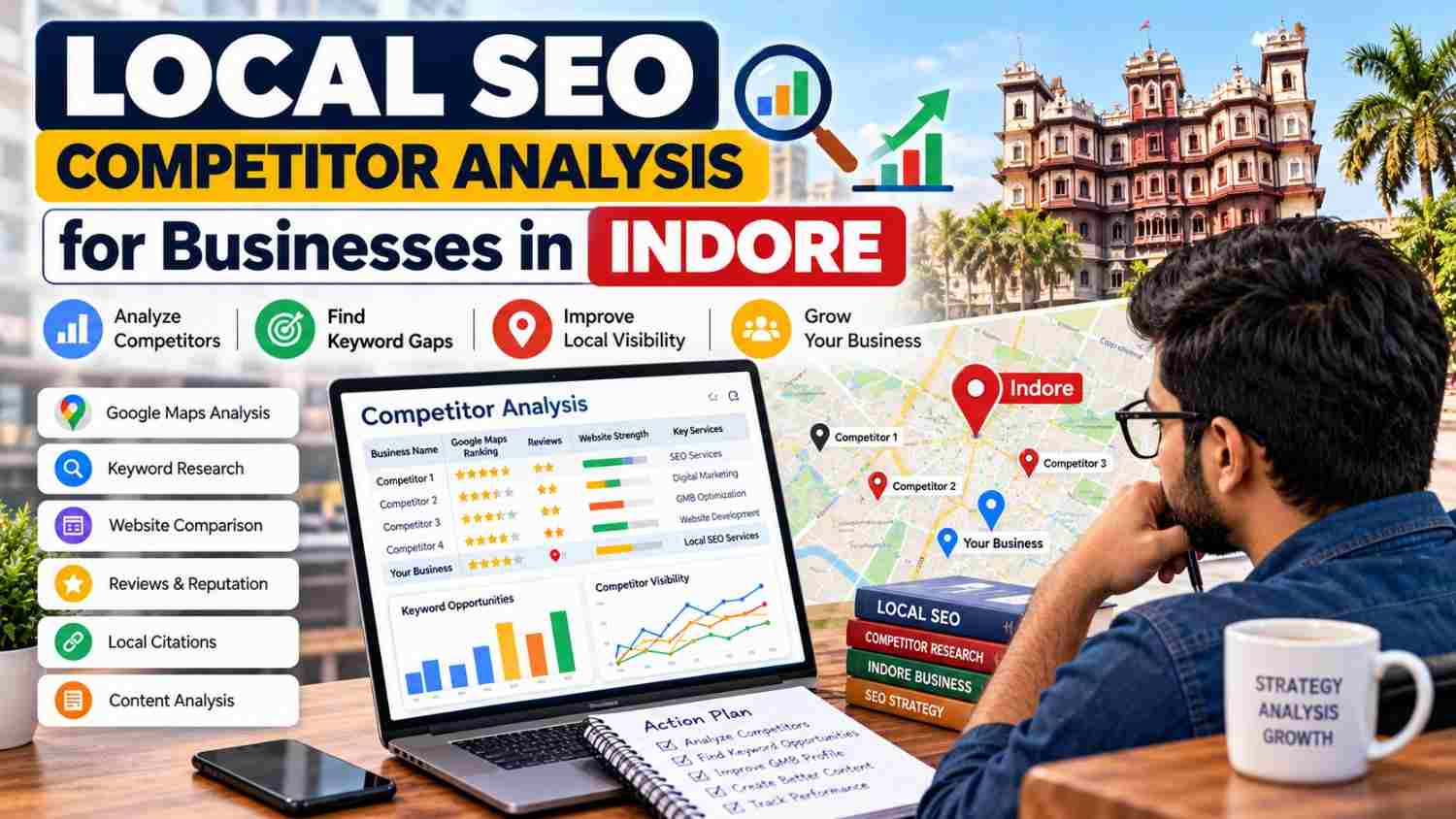
The analysis generally covers Google Maps listings, website content, keyword targeting, customer reviews, local citations and online visibility. It helps you understand what competing businesses are doing well and where opportunities exist for your own business.
There are two important types of competitors to consider:
Direct business competitors: Companies offering similar products or services to the same target customers.
Local search competitors: Businesses appearing in Google Search or Google Maps for the keywords you want to target. These may not always be your direct commercial competitors.
For instance, a business may compete with another company for a particular Google Maps search even if both offer slightly different services.
Therefore, identify competitors according to the actual search query and customer requirement rather than selecting businesses based only on their popularity.
Why Is Local SEO Competitor Analysis Important for Businesses in Indore?
Local search competition can vary according to the service, neighbourhood and search query. A company performing well for one keyword may not appear prominently for another.
Consequently, businesses should evaluate competitors across multiple relevant searches instead of relying on a single ranking observation.
A structured competitor analysis can help you:
- Identify businesses appearing for important local searches.
- Discover keyword opportunities related to your services.
- Compare Google Business Profile information and categories.
- Understand how competitors organize their service pages.
- Identify common customer questions through public reviews.
- Find gaps in content and website information.
- Evaluate local citation opportunities.
- Prioritize improvements based on business relevance.
Most importantly, this research helps you make decisions using observable information instead of assumptions about what competitors are doing.
Local SEO Competitor Analysis: 10 Essential Steps
1. Identify Your Actual Local SEO Competitors
Begin by preparing a list of businesses that offer similar services and target the same audience.
For an Indore-based business, search using your main service keywords along with relevant location terms. For example, a digital marketing agency may investigate searches such as “SEO Company in Indore”, “Local SEO Services in Indore” and “SEO Expert in Indore”.
Record the businesses appearing repeatedly across relevant search results. Also, separate direct service competitors from websites that appear only for informational searches.
Do not automatically include every business that appears in one search. Instead, focus on competitors that repeatedly target similar customers and services.
Your competitor list should include business name, website, Google Business Profile, main services, target locations and the search queries where each business appears.
2. Analyze Google Maps and Google Business Profiles
Google Maps is an important part of local search research. Review how competing businesses represent themselves through their Google Business Profiles.
Check publicly visible information such as:
- Business name and primary category.
- Additional categories, where visible.
- Business description and listed services.
- Address or service-area information.
- Website and contact details.
- Customer reviews and responses.
- Available photos and recent updates.
Also compare the businesses appearing for different relevant searches. The results may change depending on the searcher’s location and other factors.
Do not assume that the business with the highest review count or the most complete profile will always rank first. Google’s local results depend on multiple factors, including relevance, distance and prominence.
The objective is to understand how competitors communicate their offerings and identify useful improvements for your own profile.
3. Compare Competitor Website Structure and Service Pages
After reviewing business profiles, examine the websites of your main competitors.
Start with their homepage and important service pages. Understand how they organize services, explain customer benefits and present business information.
For example, an agency offering Local SEO may have separate pages for Google Business Profile optimization, local keyword research, technical SEO and website audits.
Look for differences in:
- Number and relevance of service pages.
- Quality of service descriptions.
- Page headings and content organization.
- Location-specific information.
- Contact and enquiry options.
- Internal linking structure.
- Useful supporting resources.
However, do not copy competitor page layouts or content. Use the findings to identify missing information on your own website and create more helpful pages for potential customers.
4. Research Competitor Keywords and Search Intent
Keyword research helps you understand which searches are relevant to your competitors’ services.
Start with the main keywords associated with your business. Then investigate related terms, location variations and customer questions.
For example, a company offering local SEO services in Indore may research:
- Local SEO Services in Indore.
- Local SEO Consultant in Indore.
- Google Business Profile Optimization.
- Google Maps Ranking Services.
- SEO Company in Indore.
- Local SEO Audit.
These are research examples, not verified ranking or search-volume claims.
Next, identify the intent behind each query. Some people want to learn about a service, while others are comparing providers or preparing to contact an agency.
This distinction matters because a service page and an informational blog serve different purposes.
Tools such as Google Search Console, Google Keyword Planner, Ahrefs and Semrush can support keyword research. Use their data as estimates and compare it with actual search results before selecting targets.
5. Evaluate Competitor Content Quality and Topic Coverage
Content analysis helps identify how competitors answer customer questions and explain their services.
Review their important blogs, service pages, FAQs and location-specific resources. Pay attention to whether the information is detailed, relevant and easy to understand.
For example, if several competing agencies discuss Google Business Profile optimization but do not explain profile audits, review management or category selection in sufficient detail, those subjects may offer content opportunities.
However, a content gap should be based on genuine customer requirements rather than simply publishing more articles than competitors.
Evaluate these areas:
- Accuracy and usefulness of information.
- Coverage of important customer questions.
- Original examples and practical explanations.
- Relevant supporting resources.
- Content freshness where applicable.
- Clarity of calls to action.
Your content should provide additional value rather than reproduce information already available elsewhere.
6. Compare Customer Reviews and Reputation
Customer reviews can reveal what people appreciate or dislike about competing businesses.
Read publicly available feedback and look for recurring themes. Customers may frequently mention response time, communication, service quality, pricing transparency or after-sales support.
Organize your observations into positive feedback, common complaints and unanswered customer questions.
For instance, if customers repeatedly mention delayed responses in reviews of businesses within an industry, you may identify an opportunity to improve your own enquiry-handling process.
Nevertheless, reviews represent individual experiences and should not be treated as complete evidence about a competitor’s operations.
Never create fake reviews or copy customer feedback. Use public information responsibly and focus on improving your own customer experience.
7. Review Local Citations and Business Information
Local citations are business mentions on directories, industry websites and other relevant platforms.
Check where competing businesses are listed and evaluate whether those platforms are relevant to your industry and location.
Compare publicly available business information, including name, address, phone number and website. Also identify reputable directories or industry resources that may be suitable for your own business.
Avoid submitting your details to every directory simply because a competitor appears there. Prioritize platforms that are relevant, trustworthy and useful to potential customers.
Citation research should help you discover legitimate opportunities rather than encourage unnecessary directory submissions.
8. Compare Website Experience and Technical SEO
A competitor’s website may attract search visibility while still offering a poor user experience. Therefore, review both content and technical performance.
Check whether important pages load properly, navigation works on mobile devices and contact options are easy to find.
You can evaluate publicly accessible elements such as:
- Mobile-friendly page layout.
- Website loading experience.
- Page navigation and structure.
- Broken links and visible errors.
- HTTPS security.
- Important page titles and headings.
- Clear contact information.
Tools such as Google PageSpeed Insights can help evaluate publicly accessible page performance. However, do not assume that a competitor’s technical setup or private analytics data is visible to you.
Use the findings to improve your own website experience rather than attempting to copy another site’s technical configuration.
9. Identify Competitor Strengths, Weaknesses and Content Gaps
Once the research is complete, bring the findings together in a comparison sheet.
A simple competitor analysis table can help:
| Analysis area | What to compare |
|---|---|
| Google Business Profile | Categories, services, photos and reviews |
| Website | Service pages, navigation and content |
| Keywords | Search terms and search intent |
| Reviews | Customer feedback and response patterns |
| Citations | Relevant business directory listings |
| Technical SEO | Mobile experience, speed and website errors |
| Content | Topic coverage and information gaps |
Next, identify your own strengths and weaknesses in each area.
For example, you may discover that your website already has strong service pages but lacks useful supporting blogs. Alternatively, your Google Business Profile may contain accurate information while your competitors provide more complete service descriptions.
Prioritize opportunities that are relevant to your business and realistically achievable.
10. Build an Action Plan Based on Competitor Research
Competitor analysis is useful only when the findings lead to practical improvements.
Prepare an action plan that includes the issue, proposed improvement, priority, responsible person and target completion date.
You can divide the work into three stages:
Immediate improvements: Correct inaccurate business information, fix important website errors and review incomplete profile details.
Content improvements: Strengthen existing service pages, address customer questions and create genuinely useful content around identified keyword gaps.
Long-term improvements: Monitor search visibility, review customer feedback, improve website performance and evaluate new local search opportunities.
After implementation, monitor your results using Google Search Console, Google Business Profile performance information and relevant website analytics.
Do not expect every improvement to produce an immediate ranking change. Local SEO requires ongoing monitoring and adjustments.
How to Track Local SEO Competitor Performance
Competitor research should be repeated periodically because search results and business strategies can change.
Create a tracking sheet with competitor names, target keywords, website URLs, profile information and observation dates.
For selected keywords, record which businesses appear in relevant search results. When comparing Google Maps visibility, use consistent search terms and locations wherever possible.
Also track your own website impressions, clicks, enquiries and profile interactions. These metrics help you understand whether your optimization work is contributing to meaningful business activity.
Remember that competitor rankings observed from one location are not universal. Search results may vary according to location, query and other contextual factors.
Common Local SEO Competitor Analysis Mistakes to Avoid
Businesses often collect competitor data without understanding how to use it. Avoid these common mistakes:
- Selecting competitors only because they are popular.
- Copying competitor website content or page structure.
- Assuming review quantity guarantees higher rankings.
- Targeting every keyword competitors use.
- Creating duplicate pages to match competitor URLs.
- Ignoring your own website’s existing content.
- Treating estimated SEO metrics as exact measurements.
- Making changes based on a single ranking observation.
- Ignoring customer experience while focusing only on rankings.
Instead, use competitor information as research evidence. Your strategy should reflect your own services, business goals and customer requirements.
How Sanju Web SEO Uses Competitor Analysis for Local SEO
A useful local SEO strategy begins with understanding the business, its services, target audience and geographical coverage.
At Sanju Web SEO, competitor research can support keyword planning, website content development, Google Business Profile optimization and the identification of local search opportunities.
The process should focus on identifying relevant competitors, reviewing their public search presence, analyzing keyword intent and comparing website content. These findings can then help establish priorities for your own optimization strategy.
You can explore our Local SEO Services in Indore and SEO Company in Indore pages to understand our broader SEO services.
For business profile information, visit our Google Business Profile. You can also connect with Sanju Web SEO on LinkedIn for local SEO insights, competitor research discussions and search optimization updates.
Conclusion
Local SEO competitor analysis helps businesses understand their position in the local search environment and discover opportunities to improve their online presence.
By evaluating competing Google Business Profiles, websites, keywords, reviews, citations and content, you can identify areas that need attention and build a more focused SEO strategy.
However, the goal should not be to copy competitors or chase every keyword they target. Instead, use research to create more useful content, maintain accurate business information and provide a better experience for potential customers.
If you need help reviewing your local search presence, visit Sanju Web SEO or call +91 9302110432 to discuss your requirements. You can also connect with us on LinkedIn for more local SEO insights, practical competitor research advice, Google Business Profile updates and strategies to strengthen your business visibility online.
FAQ’s:-
Q1. What is Local SEO Competitor Analysis?
Local SEO Competitor Analysis is the process of studying businesses that compete for similar local searches. It includes reviewing their Google Business Profiles, websites, keywords, reviews, citations and content strategies. Additionally, this research helps identify competitors’ strengths and weaknesses. As a result, businesses can discover opportunities to improve their own local search visibility and develop a more effective optimization strategy.
Q2. Why is competitor analysis important for businesses in Indore?
Competitor analysis helps businesses understand the local search environment and identify relevant competitors. Moreover, it reveals opportunities to improve website content, business profile information and keyword targeting. For example, businesses can compare their service pages and customer reviews with competing companies. Consequently, they can prioritize important improvements and make better-informed SEO decisions according to their business requirements.
Q3. How do I identify my local SEO competitors?
First, search for your main services using relevant location-based keywords. Next, record the businesses that repeatedly appear in Google Search and Google Maps. Additionally, separate direct business competitors from websites that appear only for informational searches. After that, compare their services, websites and search visibility. This approach helps you identify businesses targeting a similar audience and geographical area.
Q4. Should I analyze competitors’ Google Business Profiles?
Yes, reviewing competitors’ publicly available Google Business Profile information is useful. For example, you can compare their business categories, services, photos, customer reviews and profile updates. Furthermore, these observations can reveal missing information in your own profile. In addition, regular comparisons help you identify opportunities to improve your business presentation without copying another company’s content.
Q5. Which tools can help with local SEO competitor analysis?
Several tools can support different parts of competitor research. For example, Google Search and Google Maps help identify local search competitors. Meanwhile, Google Search Console provides insights into your own website’s search performance. Additionally, Google Keyword Planner can help discover keyword opportunities. Similarly, Google PageSpeed Insights, Ahrefs and Semrush can support website performance reviews and competitor research.
Q6. Can I use competitor keywords for my website?
Yes, competitor keywords can help you discover relevant search opportunities. However, evaluate each keyword according to your actual services, customer requirements and search intent before using it. Moreover, avoid copying every keyword or creating unnecessary pages. Instead, select terms that match your business objectives. Consequently, your website can attract more relevant visitors while maintaining useful and original content.
Q7. How often should I conduct competitor analysis?
A quarterly review is a practical starting point for many businesses. However, highly competitive industries may require more frequent monitoring. Additionally, review your competitors whenever you introduce new services or target another location. Similarly, investigate significant changes in your local search visibility. This regular process helps you identify new opportunities and adjust your SEO strategy when necessary.
Q8. Does competitor analysis guarantee better local rankings?
No, competitor analysis cannot guarantee better Google Maps or organic search rankings. Instead, it helps identify opportunities and guide optimization decisions. Furthermore, local search visibility depends on several factors, including relevance, distance, prominence, competition and overall online presence. Therefore, businesses should combine competitor research with accurate information, useful content and consistent SEO improvements.
Q9. What should I compare when analyzing competitor websites?
Review their service pages, content quality, keyword targeting, navigation, mobile experience, technical performance and contact options. Additionally, examine how clearly they explain their services and answer customer questions. For example, identify topics that competitors have not explained properly. Based on these findings, improve your own website with more useful information. Ultimately, the objective is to provide a better user experience rather than copy competitor content.
Q10. Can Sanju Web SEO help with local competitor analysis in Indore?
Yes, Sanju Web SEO provides local SEO and website optimization services. Through competitor research, businesses can identify relevant search opportunities, content gaps and keyword targeting improvements. Moreover, a structured analysis helps determine which areas need attention. Additionally, the findings can support a practical optimization plan based on business goals and local competition. Therefore, businesses can make more informed decisions about improving their online presence and attracting relevant customers.