How SEO for Event Venues Helps Increase Online Visibility and Bookings
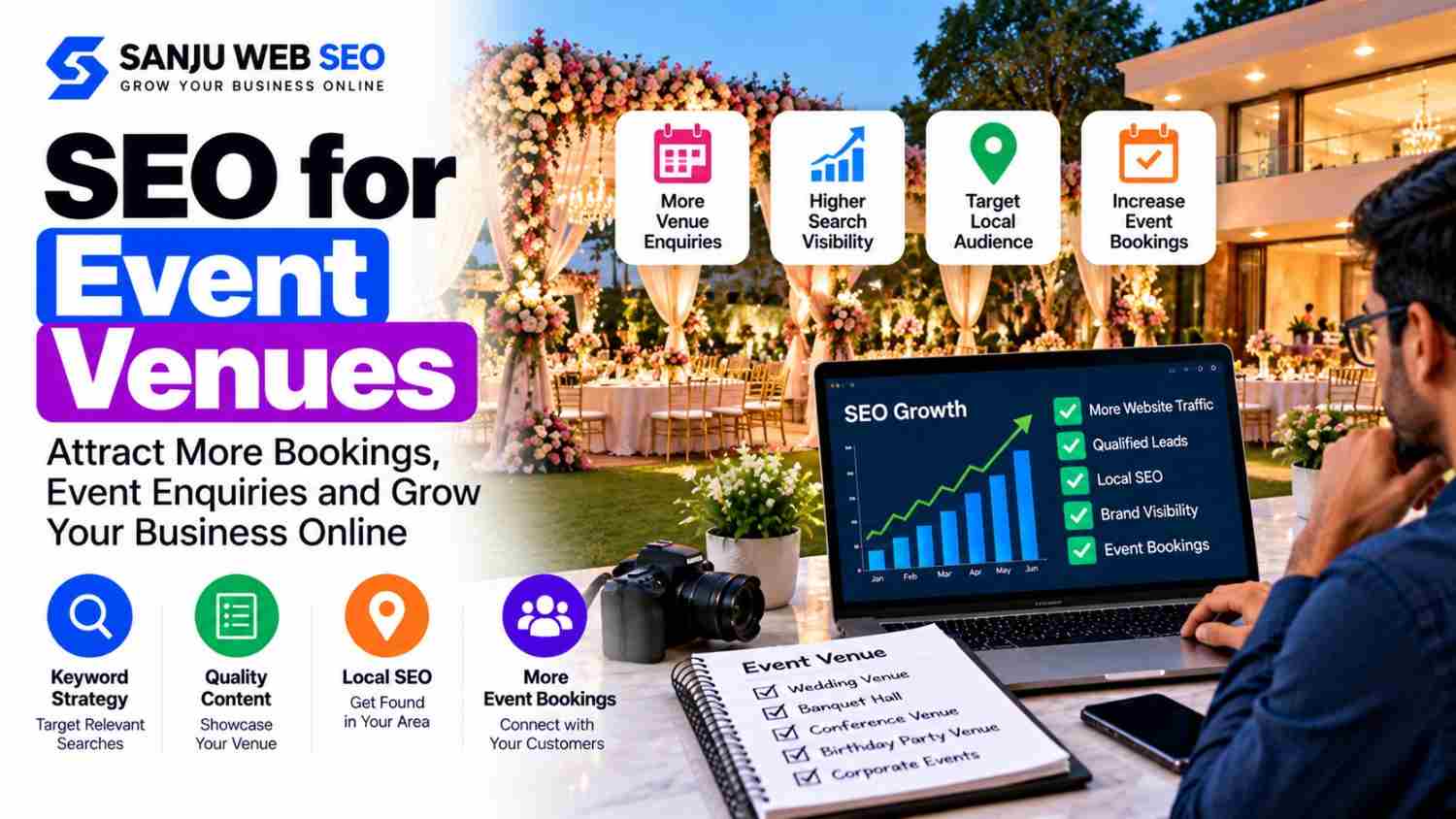
SEO for Event Venues helps wedding venues, banquet halls, conference centres, and event spaces reach people searching for suitable locations for their upcoming events. By improving website visibility, creating helpful content, and optimising venue pages, businesses can attract relevant visitors and generate more booking enquiries through organic search.
However, choosing an event venue involves more than finding a nearby location. Customers may compare capacity, pricing, facilities, parking, catering options, accessibility, and the overall atmosphere before making a decision. Therefore, your website must provide clear information and help visitors understand whether your venue suits their event.
Whether you manage a wedding lawn, a banquet hall, a corporate conference venue, or a flexible event space, a well-planned SEO strategy can help you reach potential customers at the right stage of their search.
In this guide, we will explore practical ways to improve search visibility, attract qualified enquiries, and turn website visitors into venue bookings.
1. Understand How Customers Search for Event Venues
Before choosing keywords, identify your main customer groups and the types of events your venue can accommodate. A couple planning a wedding may search differently from a business looking for a conference room or a family organising a birthday celebration.
Consequently, your keyword strategy should reflect the venue’s actual facilities, location, and intended audience.
Potential keyword groups include:
- Wedding venues: wedding venue, wedding hall, marriage garden, and wedding reception venue.
- Banquet facilities: banquet hall, party hall, and celebration venue.
- Corporate events: conference venue, corporate event space, and meeting venue.
- Private celebrations: birthday party venue, anniversary celebration venue, and family function hall.
- Location-based searches: wedding venue in a particular city, banquet hall near a neighbourhood, or conference venue in a business district.
These are example keyword themes, not verified search-volume figures. Use keyword research tools to evaluate demand, competition, and relevance before selecting your final targets.
Match Keywords to Search Intent
Different searches indicate different needs. Someone searching for wedding venue ideas may still be exploring options, while a person searching for a banquet hall with a particular capacity may be closer to making a booking.
Therefore, create a clear relationship between search intent and website pages. An informational article can help people plan an event, while a dedicated venue page should explain facilities, capacity, location, and enquiry options.
Avoid targeting every venue-related keyword on one page. Instead, organise the website around distinct venue types and customer requirements.
2. Create Dedicated Pages for Different Venue Types
If your business offers multiple spaces or event services, a single generic page may not provide enough detail for every potential customer.
For example, a wedding lawn may appeal to customers planning large celebrations, whereas a conference room may serve businesses looking for professional meeting facilities. If these offerings have distinct audiences and search intent, separate pages can help explain them clearly.
What Should a Venue Page Include?
Each important venue page should answer the questions visitors are likely to ask.
- What types of events can the venue accommodate?
- What is the seating or guest capacity?
- Which facilities and amenities are available?
- Is catering available, and what are the arrangements?
- Is parking available for guests?
- Where is the venue located?
- How can visitors enquire about dates and pricing?
Additionally, include genuine photographs that accurately represent the venue. Where possible, show the entrance, event spaces, seating arrangements, stage area, and other relevant facilities.
Keep capacity and facility details accurate. If certain amenities are available only with specific packages, explain those conditions rather than presenting them as standard inclusions.
A detailed venue page helps visitors decide whether the location matches their event requirements before contacting your team.
3. Improve Local SEO for Event Venues
Event venues often depend on customers searching within a particular city or region. Therefore, local SEO can be an important part of a venue’s customer acquisition strategy.
Start by identifying the locations you genuinely serve. Then, make sure your website clearly communicates the venue’s address, accessibility, nearby landmarks where relevant, and the types of events it accommodates.
Optimise Your Google Business Profile
If your venue is eligible for a Google Business Profile, keep the business name, category, address, contact information, operating hours, website, and other details accurate.
Choose categories that genuinely describe the business. Avoid selecting unrelated categories simply to appear for more searches.
Add authentic photographs of your event spaces and facilities. You can also encourage genuine customer reviews in accordance with Google’s policies and respond professionally to feedback.
Furthermore, make sure the information on your website matches the details shown on your business profile. Customers should be able to find the correct location and contact your team without confusion.
You can also review the Sanju Web SEO Google Business Profile as an example of a business profile used to support local visibility.
Create Useful Location Pages
If your business operates multiple venues in different areas, separate location pages may be useful when each page provides unique, accurate information.
Include the actual address, venue facilities, capacity, photographs, available event types, and enquiry details for each location.
However, avoid creating numerous pages that differ only by the city name. Each page should help visitors understand the specific venue and its suitability for their event.
Only promote locations that genuinely exist and are available to customers.
4. Publish Helpful Content About Event Planning
Content marketing can introduce your venue to potential customers before they are ready to book. It also allows you to answer common questions and demonstrate an understanding of event planning requirements.
Start by identifying the questions your sales team regularly receives from customers.
For example, wedding customers may need help comparing venue capacities and facilities. Corporate organisers may want to understand how to select a conference location, while families may be researching spaces for private celebrations.
Choose Topics That Help Customers Make Decisions
Useful content ideas include:
- Questions to ask before booking a wedding venue.
- How to choose a banquet hall for a family function.
- What to consider when selecting a corporate event space.
- How guest capacity affects venue selection.
- Which facilities to compare when choosing an event location.
Each article should provide meaningful information instead of simply repeating promotional claims.
Moreover, link relevant articles to appropriate venue pages when that connection helps readers explore available options. For instance, a guide to choosing a wedding venue can link to your wedding venue page.
Businesses developing a wider organic acquisition strategy can also review SEO for Lead Generation for related ideas on connecting search traffic with business enquiries.
5. Use High-Quality Venue Photography and Video
People often rely heavily on visual information when comparing event venues. Photographs help them understand the space, atmosphere, layout, and facilities before arranging a visit.
Therefore, use genuine, high-quality images that represent your venue accurately.
Include photographs of different areas, such as the main hall, outdoor spaces, seating arrangements, stage, entrance, and available amenities. If your venue supports different event layouts, show examples that reflect those arrangements.
Optimise Images for Search and Usability
Use descriptive image filenames and meaningful alternative text where appropriate. For example, an image showing a banquet hall set up for a wedding should have alt text that accurately describes the scene.
However, avoid inserting the same keyword into every image’s alt text. Accessibility and accurate descriptions should come first.
Also, compress large images appropriately to reduce loading times while maintaining acceptable visual quality.
If you publish videos, ensure that visitors can access the important venue information without being forced to watch a video. Supporting text and clear page headings remain useful for both users and search engines.
Authentic visual content can help customers evaluate your venue while setting realistic expectations before their visit.
6. Build Trust With Accurate Information and Genuine Reviews
Booking an event venue can involve a significant expense and careful coordination. Customers may want reassurance that the facilities, service arrangements, and booking terms match their expectations.
Therefore, provide clear and accurate information about your business, venue facilities, policies, and booking process.
Display Genuine Customer Experiences
Where you have permission, share authentic testimonials or event photographs from previous customers. These can help visitors understand the experience your venue provides.
You may also publish case studies describing a real event, the venue requirements, and how the space was arranged to meet those needs.
However, do not invent testimonials or imply that every event will produce the same experience. Obtain appropriate permission before publishing customer photographs or identifying details.
Similarly, explain important booking conditions clearly. If deposits, cancellation terms, catering arrangements, or decoration restrictions apply, provide accurate information before customers make a decision.
Trust develops when your website reflects the actual experience visitors can expect.
7. Make Booking Enquiries Easy
Organic visibility is only one part of the process. Your website must also help interested visitors take the next step.
Depending on your business, this may involve requesting a quotation, checking availability, scheduling a venue tour, or contacting your booking team.
Use Clear Calls to Action
Each venue page should provide an appropriate next step. For example, a wedding venue page might invite visitors to enquire about available dates, while a conference venue page could offer a request form for corporate bookings.
Keep forms straightforward and ask only for information that helps your team respond.
Depending on the venue, useful fields may include:
- Event type.
- Preferred event date.
- Approximate number of guests.
- Venue or location preference.
- Contact details.
Additionally, explain what happens after a customer submits an enquiry. If availability needs to be confirmed by your team, make that clear.
Explain Pricing and Booking Conditions
Customers may compare several venues before deciding. Therefore, explain your pricing structure as clearly as possible.
If the cost depends on the event date, guest count, duration, package, or selected facilities, describe those factors. If you provide customised quotations, explain how customers can request one.
Avoid displaying misleading starting prices without clarifying the conditions that apply.
A transparent booking process can help attract enquiries from customers whose requirements match your venue.
8. Strengthen Internal Linking Across Your Website
Internal links help visitors discover related information and help search engines understand the relationship between pages.
For example, an article about planning a corporate conference can link to your conference venue page. A guide to choosing a wedding location can link to your wedding venue or banquet hall page.
However, links should be useful and contextually relevant. Adding unrelated links simply to increase the link count can disrupt the reader’s experience.
Before publishing a new article, review your existing content inventory. If a published page already covers the same topic and search intent, consider improving that page instead of creating a competing URL.
Also, use descriptive anchor text so readers understand what they will find after clicking.
A clear internal linking structure helps customers move naturally from planning resources to venue details and booking enquiries.
9. Measure SEO Performance and Booking Enquiries
SEO for Event Venues should be evaluated using both search visibility and business outcomes.
Google Search Console can help you review search queries, impressions, clicks, click-through rates, and page-level performance. Suitable analytics tools can provide additional information about visitor engagement and enquiry actions, depending on your configuration.
Track metrics such as:
| Metric | What it helps you understand |
|---|---|
| Organic impressions | How often eligible pages appear in search results |
| Organic clicks | How many visits arrive from organic search |
| Click-through rate | How often impressions result in clicks |
| Average position | An aggregate indication of search visibility |
| Venue-page engagement | Whether visitors interact with important pages |
| Availability enquiries | How often customers ask about dates |
| Venue tour requests | How many prospects want to visit |
| Qualified booking leads | Whether enquiries match your venue offering |
Do not evaluate every page using the same expectations. An event-planning article may attract early-stage visitors, while a venue page may generate fewer visits but more booking enquiries.
Therefore, review traffic alongside lead quality and booking outcomes. This provides a more useful understanding of which pages contribute to business growth.
10. Follow a Practical 90-Day SEO Plan
A phased plan helps event venue businesses improve their websites while focusing on the most valuable opportunities first.
Days 1–30: Audit and Prioritise
Review existing venue pages, keyword targeting, location information, technical SEO, internal links, and search performance.
Identify pages that already attract relevant impressions, pages with weak click-through rates, and important venue types that lack useful landing pages.
Also, map keywords to existing URLs before planning new articles. This helps identify genuine content gaps and reduces unnecessary duplication.
Days 31–60: Improve Priority Pages
Update important venue pages, improve photographs and descriptions, strengthen internal links, and resolve significant technical issues.
Make enquiry forms easier to use and clarify availability and pricing information where possible.
Publish useful event-planning content based on real customer questions and relevant keyword opportunities.
Days 61–90: Measure and Refine
Compare results with your initial baseline. Review organic clicks, impressions, venue-page engagement, availability enquiries, and qualified booking leads.
Identify which improvements appear effective and where further work is needed.
Search competition, seasonality, location, and website conditions vary. Therefore, avoid promising specific rankings or booking numbers within a fixed period.
Regular evaluation helps refine the strategy using actual evidence rather than assumptions.
Common SEO Mistakes Event Venues Should Avoid
Several mistakes can reduce the effectiveness of an otherwise useful SEO strategy.
- Targeting irrelevant keywords: Focus on searches that match your venue types and services.
- Using generic venue descriptions: Explain the actual capacity, facilities, and event options.
- Creating repetitive location pages: Publish location-specific content only when it provides genuine value.
- Using misleading photographs: Show authentic facilities and accurately represent the venue.
- Hiding booking conditions: Explain pricing factors, availability enquiries, and relevant policies clearly.
- Ignoring mobile usability: Make venue information and enquiry forms easy to use on smaller screens.
- Measuring traffic alone: Review qualified enquiries, venue tours, and booking outcomes alongside search visibility.
Avoiding these mistakes helps create a more sustainable approach to online visibility and venue bookings.
Grow Your Event Venue Business With a Practical SEO Strategy
Event venues need more than website visitors. They need to reach people who are actively planning events and looking for a location that fits their requirements.
Start by improving your venue pages, answering genuine customer questions, and strengthening local visibility. Then, measure whether the resulting traffic leads to meaningful enquiries and bookings.
If you need help with keyword research, website optimisation, content planning, or organic lead generation, Sanju Web SEO can help you identify opportunities and develop a practical strategy aligned with your business goals.
Visit Sanju Web SEO to explore our services. You can also connect through our Google Business Profile or follow Sanju Web SEO on LinkedIn for SEO insights and digital marketing updates.
To discuss your website and growth objectives, contact Sanju Web SEO at +91 9302110432.
FAQ’s:-
Q1. How does SEO for Event Venues help attract more bookings?
SEO for Event Venues helps businesses reach people searching for wedding venues, banquet halls, conference centres, and event spaces. Relevant venue pages and helpful planning content can attract potential customers who are comparing locations. Actual bookings depend on venue suitability, availability, competition, pricing, and the quality of the enquiry process.
Q2. Which keywords should event venues target?
Event venues should research keywords related to their actual facilities, event types, and service locations. Examples include wedding venue, banquet hall, conference venue, and birthday party venue. Validate search intent and keyword data before assigning terms to individual pages.
Q3. Why is SEO for Event Venues important for local businesses?
SEO for Event Venues can help local businesses reach customers searching for suitable event spaces in their area. Accurate business information, useful venue pages, authentic photographs, and relevant location content can support discovery. However, local rankings depend on several factors and cannot be guaranteed.
Q4. How long does SEO for Event Venues take to show results?
SEO for Event Venues has no guaranteed timeline. Website improvements may help visitors sooner, while sustainable organic growth can take longer. Competition, seasonality, local demand, and website quality all influence performance. Regularly review search visibility and booking enquiries to assess progress.
Q5. Should event venues create separate pages for weddings and corporate events?
Separate pages can be useful when weddings and corporate events involve different audiences, facilities, and booking requirements. A wedding page may explain guest capacity and celebration arrangements, while a corporate page can describe meeting facilities and event services. Each page should provide unique and useful information.
Q6. Can SEO for Event Venues help banquet halls attract more customers?
SEO for Event Venues can help banquet halls reach people searching for celebration spaces, wedding receptions, and family function venues. Detailed service pages, accurate capacity information, genuine photographs, and clear enquiry options can help interested visitors evaluate the venue. Results depend on local competition and customer requirements.
Q7. How can event venues improve their Google Business Profile?
Event venues should maintain accurate business details, choose relevant categories, add genuine photographs, and follow Google’s review policies. They should also ensure that their website and profile provide consistent information. These actions can support local discovery but do not guarantee higher rankings.
Q8. What content should event venues publish for SEO?
Useful content may cover venue selection, guest capacity, event planning, booking questions, and facility comparisons. Articles should answer genuine customer questions and link naturally to relevant venue pages. Avoid publishing repetitive articles that offer little additional value.
Q9. How should businesses measure SEO for Event Venues?
Businesses should monitor organic impressions, clicks, venue-page engagement, availability enquiries, venue tour requests, and qualified booking leads. Google Search Console helps analyse search visibility, while suitable analytics tools can measure website actions. Reviewing lead quality alongside traffic gives a more useful picture of business impact.
Q10. Can SEO for Event Venues help attract wedding and conference bookings?
SEO for Event Venues can help businesses reach couples, families, and organisations searching for appropriate event locations. Dedicated pages for different event types can explain relevant facilities, capacity, and booking arrangements. The strategy should reflect the venue’s actual services, location, and available facilities.